National Palace of Sintra: Tickets, Hours, Rooms and How to Visit
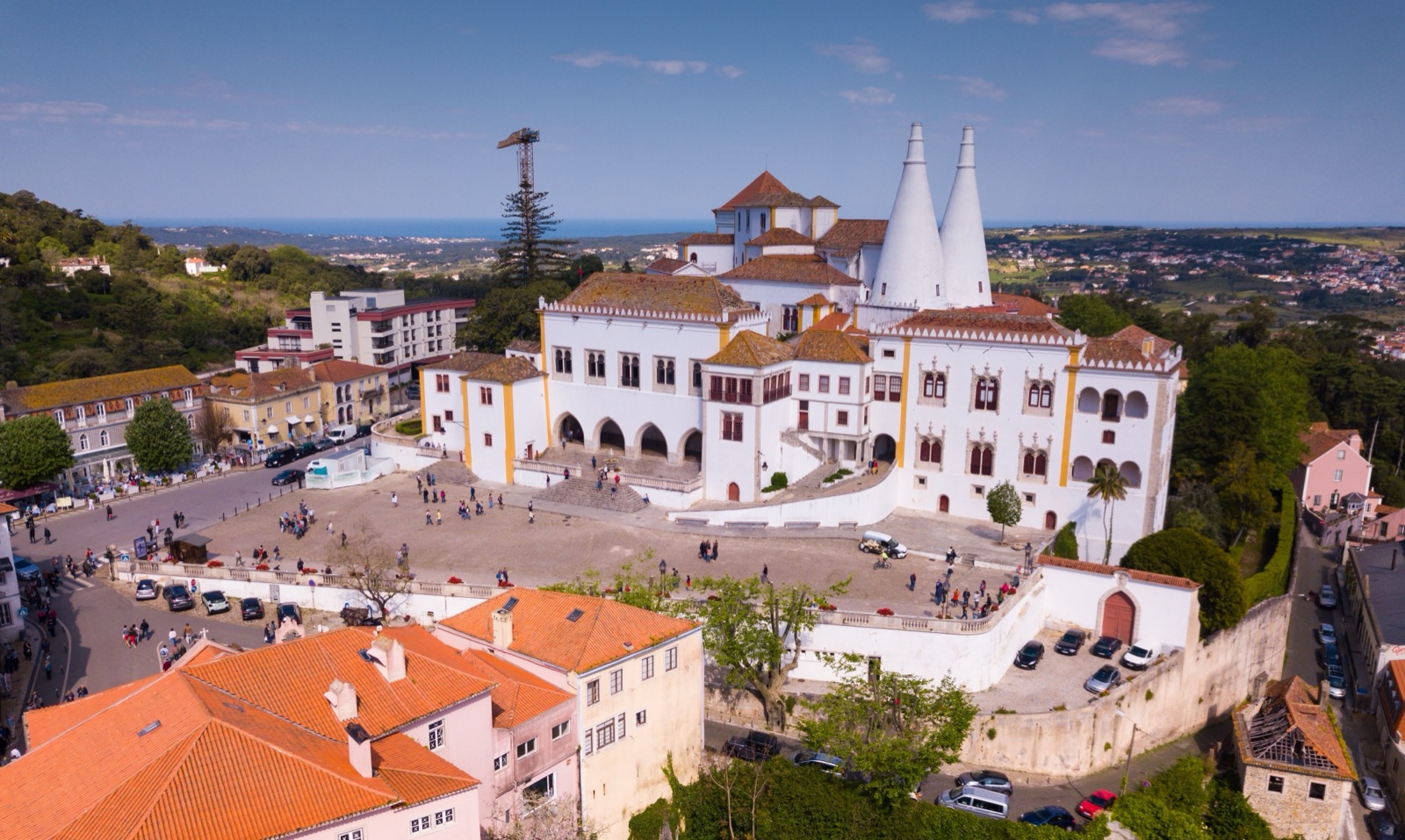
The National Palace of Sintra is the white palace with the two giant conical chimneys in the middle of Sintra’s historic centre, and it is the easiest of the town’s big monuments to visit: it stands on the main square, 10–15 minutes from the train station, and opens every day from 9:30 to 18:30. A self-guided Essential Visit costs €13 for adults, €10 for youths aged 6–17 and seniors, and nothing for children under 6. Most people need about an hour and a half inside, more if they add Queen Maria Pia’s Residence on the Full Visit.
It is also the least crowded of the famous three. In 2025 the palace had 400,000 visitors, against 1.9 million at Pena, so it is the obvious place to go first thing, in the middle of the day while Pena’s queues peak, or on a misty morning when the hilltop views are gone. This guide covers the ticket options, the hours and the lunchtime ticket-office gap, what to see room by room, the gardens and café you can visit for free, step-free access, and how the palace fits into a day in Sintra. Prices and hours are as published by Parques de Sintra, the public company that runs the palace, in November 2026; check before you go.
The palace at a glance
- Where: Largo Rainha D. Amélia, the main square of the historic centre.
- Run by: Parques de Sintra, since September 2012.
- Hours: 9:30–18:30, every day; last ticket and admission at 17:30.
- Gardens: free, 9:30–18:30, last admission 18:00.
- Closed: 24, 25 and 31 December and 1 January.
- Essential Visit: €13 adults, €10 youths and seniors, free under 6, €35 for a family of two adults and two youths.
- Full Visit: €35 adults, with Queen Maria Pia’s Residence in a small group.
- From the station: 10–15 minutes on foot, or buses 434 and 435.
Why this palace is different
Pena and Regaleira are 19th- and early 20th-century fantasies. The National Palace is the real thing: a working royal residence used, altered and extended for most of Portugal’s history. Parques de Sintra calls it the only palace that spans the whole history of the country. The first building probably went up around the 10th or 11th century, when Sintra was under Moorish rule, and the first document recording a palace on the site dates from 1281.
That long life explains its odd shape. Instead of one design, you walk through a cluster of buildings joined over centuries, with Gothic, Manueline and Mudéjar work side by side. The rooms you see owe most to four kings: Dinis, João I, Manuel I and João III. Almost every king and queen of Portugal spent time here, and in 1910, when the monarchy fell, Queen Maria Pia left the palace for exile. The same year it was declared a National Monument, but it only opened regularly to the public as a museum in the late 1930s.
Which ticket to buy
Parques de Sintra sells four ways in. For most visitors the Essential Visit is enough; the Full Visit is worth it if you like interiors and want a quieter, smaller-group section.
| Visit | Adult | Youth (6–17) | Senior (65+) | Family | What you get |
|---|---|---|---|---|---|
| Essential | €13 | €10 | €10 | €35 | Self-guided route + gardens |
| Full | €35 | €20 | €25 | €95 | Essential + Queen Maria Pia’s Residence, small group |
| Guided | €45 | €20 | €35 | €105 | 1-hour guided tour incl. the Residence |
| Theatrical | €65 | €20 | €50 | €130 | Live theatre in the Residence |
Children under 6 go free on every visit type. Visitors with disabilities get 70% off here (more than the 50% at Pena and the other parks), and anyone accompanying them pays nothing.
The Essential Visit
The standard route takes in the rooms open to all visitors and the gardens, at your own pace. Free digital resources come with it, including Zoomguide, the palace’s own audio guide with built-in artificial intelligence, a virtual tour and a Sintra Palace treasure hunt. Lockers are available next to the ticket office, which helps if you are carrying a day bag for Pena later.
The Full Visit and Queen Maria Pia’s Residence
The Full Visit adds one of the most private parts of the building: the residence of Queen Maria Pia, recently conserved and redisplayed. It is visited in a small group and shows daily life in the late 19th and early 20th centuries, in the last years of the Portuguese monarchy. Queen Maria Pia of Savoy (1847–1911) was the last queen to live in this palace.
The guided visit
A specialist guide leads a 1-hour tour that includes the Residence. It starts at 3 p.m. and is in Portuguese and English; the palace recommends arriving a few minutes early.
The theatrical visit
On Thursdays at 3:30 pm, actors stage a 1-hour performance in Queen Maria Pia’s Residence for at most 20 people, set in the final years of the monarchy. The general price list shows €65 for adults, but the theatrical visit’s own page says prices are on request and asks you to contact the palace to book, so ask before you plan around it. Arrive at least 15 minutes early: after a 15-minute tolerance, your place is no longer guaranteed. You can walk the standard route before or after.
Hours, the lunch gap and closures
The palace opens 9:30–18:30 every day, with the last ticket and last admission at 17:30. Two details catch people out:
- The ticket office closes from 12 pm to 1 pm. Automatic machines keep selling tickets, but if you need an in-person ticket (a discount, a question), avoid that hour.
- Last admission is 17:30, an hour before closing.
Like all the Parques de Sintra monuments, the palace closes on 24, 25 and 31 December and 1 January, and occasionally for State events. One advantage over the hill sites: it is in the town, not the forest. When fire risk closed Pena and the Moorish Castle in July 2026, the National Palace stayed open.
Buying online needs a date, but there is no time slot here, and you can reschedule the date on the Parques de Sintra website within a year. Buying several Parques de Sintra sites together gives a discount, from 5% for two up to 10% for six; our guide to Sintra’s palaces and tickets explains how the combinations work.
Getting there
The palace is the centre of town, so getting there is the simple part:
- On foot from the station: 10–15 minutes into the historic centre.
- By bus: the 434 (Pena circuit) and 435 (Monserrate circuit) both serve the National Palace.
- By car: don’t drive into the centre. Private cars may only circulate there if they belong to residents. Park on the edge, for example at the Lourel car park with its 509 free spaces, and walk or take a bus in.
Our guide to getting to Sintra from Lisbon covers the train from Rossio (about 45 minutes) and the buses in detail.
What to see inside
The route starts in the arcades facing the square. In the Middle Ages, spaces like this were where contracts were agreed, wills written and disputes settled, before notaries and judges in the service of the queen, who held the lands of Sintra. From the 13th century onwards, giving Sintra to the queens of Portugal became a constant practice: in 1287 King Dinis gave the palace and town to his wife, Queen Elizabeth, also known as Isabel of Aragon (see the chapel below).
The Swan Room
This was the Great Hall of the palace in the time of João I and Philippa of Lancaster, and it is the largest room in the building. Until the 19th century it hosted banquets, concerts, receptions and even funerals. The ceiling panels, believed to date from the 14th century, are painted with crowned swans, an emblem of Philippa’s brother, Henry IV of England.
The Magpie Room
Next comes the room used for royal audiences. Its ceiling, believed to be the oldest painting in the palace, shows 136 magpies. Each holds João I’s banner with his motto, por bem (“for good”), and a rose in its claws that may refer to the House of Lancaster. Nobody knows exactly what the magpies mean, which has not stopped the stories.
The Galley Room and the chambers
A gallery built for João III connected his chambers to the north-west wing. Its 17th-century ceiling shows Portuguese, Ottoman and Dutch galleys, apparently remembering an event whose meaning is now lost. Nearby is the Chamber of Afonso VI, a sadder story: the king, deposed by his brother, was held in the room that still bears his name from 1674 until his death nine years later.
The Room of the Coats of Arms
The high point of the visit, literally: it sits in the highest part of the palace. Manuel I placed his own coat of arms at the centre of the cupola, surrounded by those of his children and the 72 leading noble households of the kingdom, a statement in heraldry of who stood where. Parques de Sintra describes it as the most important heraldry room in Europe. The tiles on the walls, scenes of gallantry, were added in the 18th century.
The chapel
One of the oldest parts of the building, the chapel dates from the reign of Dinis and Isabel of Aragon in the 13th century. Its Mudéjar ceiling, a blend of Christian and Islamic craft, is one of the best preserved in Portugal. During Mass, the king sat hidden behind a curtain beside the main chapel.
The kitchen and its chimneys
The two cones you see from everywhere in Sintra are the chimneys of the royal kitchen, built by João I to serve the whole palace and a court of several hundred people. Each is 33 metres high. Game hunted in the hills was prepared here for banquets. From inside, the scale of the cones is easier to grasp than from the square.
The Manueline Room
Built as the Great Hall of Manuel I, this room was later split by partitions into the chambers of King Luís I, then restored to its original size in the 1930s. It shows three eras in one space: the medieval court, the more domestic palace of the Constitutional Monarchy after 1822, and the 20th-century restorers who rebuilt the past to suit the dictatorship’s story.
The Central Patio and the Water Grotto
The patio let people move around João I’s palace without going through the rooms. At its centre is a 16th-century water spout in the form of a twisted column. Off it, the Water Grotto, built at the end of the 15th or early 16th century and redecorated in the 18th, is a cool nook where water spurts from tiny holes in the walls, a courtly joke on hot afternoons.
A newer highlight: since 2019 the route has included a rare 17th-century State Bed, a unique piece in Portugal.
The gardens and the café, free
The palace gardens are free to enter, open 9:30–18:30 with last admission at 18:00, and many visitors never find them. They step down in terraces on the west side:
- The Preta Garden, recently restored, is a natural viewpoint over the Sintra hills and the historic centre. A large Manueline twisted column stands at its centre; until the early 20th century it stood in the square in front of the palace.
- The Araucaria Garden, the Kitchen Garden, the Tanquinhos Patio and the Princes’ Garden complete the set, all with views.
The Lion Patio cafeteria, in one of the inner courtyards, has a Moorish-style water mirror, an indoor room and a terrace. It opens 9:30–18:30 and you can reach it from outside through the free gardens, so it works as a break even if you are not visiting the palace.
How long to allow
- Essential Visit: about an hour and a half for the rooms, plus time in the gardens. Parques de Sintra’s own itinerary allows 10 minutes for the Swan Room, 5 for the Magpie Room and 15 for Queen Maria Pia’s chambers, then 30 minutes for a café break before the gardens.
- Full or guided visit: add an hour.
- With the gardens and café: two to two and a half hours is relaxed.
If you are doing Pena and the Moorish Castle the same day, an hour and a half is the realistic budget here.
When to go
The palace has a fraction of Pena’s crowds, but tour groups pass through it on day trips from Lisbon. Three ways to get the rooms at their quietest:
- Be there at 9:30. The park’s own walking itinerary starts here at 9:30 for exactly that reason.
- Go at lunchtime. Many day visitors aim to be up at Pena around then, so the town palace can be a good midday choice. Remember the ticket office’s 12–1 pm break and use the machines.
- Save it for bad weather. On a foggy or wet morning, when Pena’s terraces show you nothing, the National Palace loses nothing at all.
Residents of Portugal enter Parques de Sintra sites free on Sundays and public holidays, so those days can be busier with local families.
Access, children and the rules
The palace is old and full of stairs, but Parques de Sintra has done more than most:
- Step-free entry is through the palace kitchen, as the main entrance has several flights of steps. Staff can provide traction equipment for the slope and the cobbles.
- Ramps to the Manueline Room and to the Swan Room are laid on request. Book ahead; without a reservation, expect to wait about 15–20 minutes while they are set up.
- A stair climber, run by staff, handles steps of up to 20 cm between the Archers’ Room and the Central Patio, and lifting platforms reach the Preta Garden.
- The accessible area totals around 1,820 square metres; the rest of the route has steps.
- A manual wheelchair with a traction chassis can be reserved, and visitors with disabilities can request tickets by form at least 3 working days ahead.
- A tactile scale model of the palace helps blind and partially sighted visitors.
Children under 6 go free, and the digital treasure hunt gives children something to look for. Photography is allowed for personal use without a tripod or flash. As at all Parques de Sintra sites, you cannot bring food in, and pets are not allowed (dogs are welcome only at the Moorish Castle and the Park of Monserrate).
A short history to carry round
A few dates make the rooms easier to read:
- 10th–11th century: first buildings, under Moorish rule.
- 1147: after Afonso Henriques takes Lisbon, Sintra’s Almoravids surrender.
- 1281: first document recording the palace.
- Late 14th–early 15th century: João I builds the Swan Room, the Central Patio and the kitchen; in 1413 he receives here the spies who scouted Ceuta, the start of Portugal’s expansion overseas.
- Early 16th century: Manuel I adds the tiles and the Room of the Coats of Arms.
- 1755: the great earthquake badly damages the palace; it is rebuilt with its old silhouette.
- 1910: end of the monarchy; National Monument.
- 2012: Parques de Sintra takes over; the palace joins the European Royal Residences Network in 2013.
Fitting it into your day
The palace is where Sintra’s walking routes begin. Two good shapes for a day:
- Town first, hills after. Start here at 9:30, walk 15 minutes through the old town to the Church of Santa Maria, then take the marked footpath up to the Moorish Castle (about 45 minutes) and on to Pena. That is Parques de Sintra’s own suggested day, and our one day in Sintra guide sets it out with timings.
- The Pena Trail ticket. Parques de Sintra sells a €35 walking ticket, “From the Town to the Hills: The Pena Trail”, that starts with entry to this palace and continues on foot through Villa Sassetti and the Moorish Castle into Pena Park, in about 3 hours. It includes the park but not the inside of Pena Palace. Our guide to hiking in Sintra explains the route.
If you would rather have the logistics handled, small-group and private tours from Lisbon cover the town and the hill palaces in one day; compare them on our tours page. For Pena itself, see our Pena Palace guide.
Frequently asked questions
How much is the National Palace of Sintra ticket?
The Essential Visit costs €13 for adults, €10 for youths aged 6–17 and seniors over 65, and €35 for a family of two adults and two youths. Children under 6 go free. The Full Visit, with Queen Maria Pia’s Residence, costs €35 for adults.
What are the opening hours?
9:30 to 18:30 every day, with last ticket and admission at 17:30. The ticket office closes from 12 pm to 1 pm, when machines are available. It closes on 24, 25 and 31 December and 1 January.
Is the National Palace of Sintra worth visiting?
Yes, especially if you want real history rather than Romantic fantasy. It is the only Sintra palace that spans most of Portugal’s history, its painted ceilings and tiles are outstanding, and it is far less crowded than Pena.
How long do you need at the National Palace?
About an hour and a half for the Essential Visit, plus time for the free gardens. Allow an extra hour for the Full or guided visit.
Do I need to book in advance?
There are no time slots, so you can buy at the door or from the machines. Booking online fixes a date, which you can change within a year, and buying several Parques de Sintra sites together earns a discount.
Can you visit the gardens without a ticket?
Yes. The gardens, including the restored Preta Garden, are free and open 9:30–18:30, and the Lion Patio cafeteria can be reached from them.