Culture & film
Monserrate Palace: Sintra's Moorish-Gothic Villa and Its Botanical Park
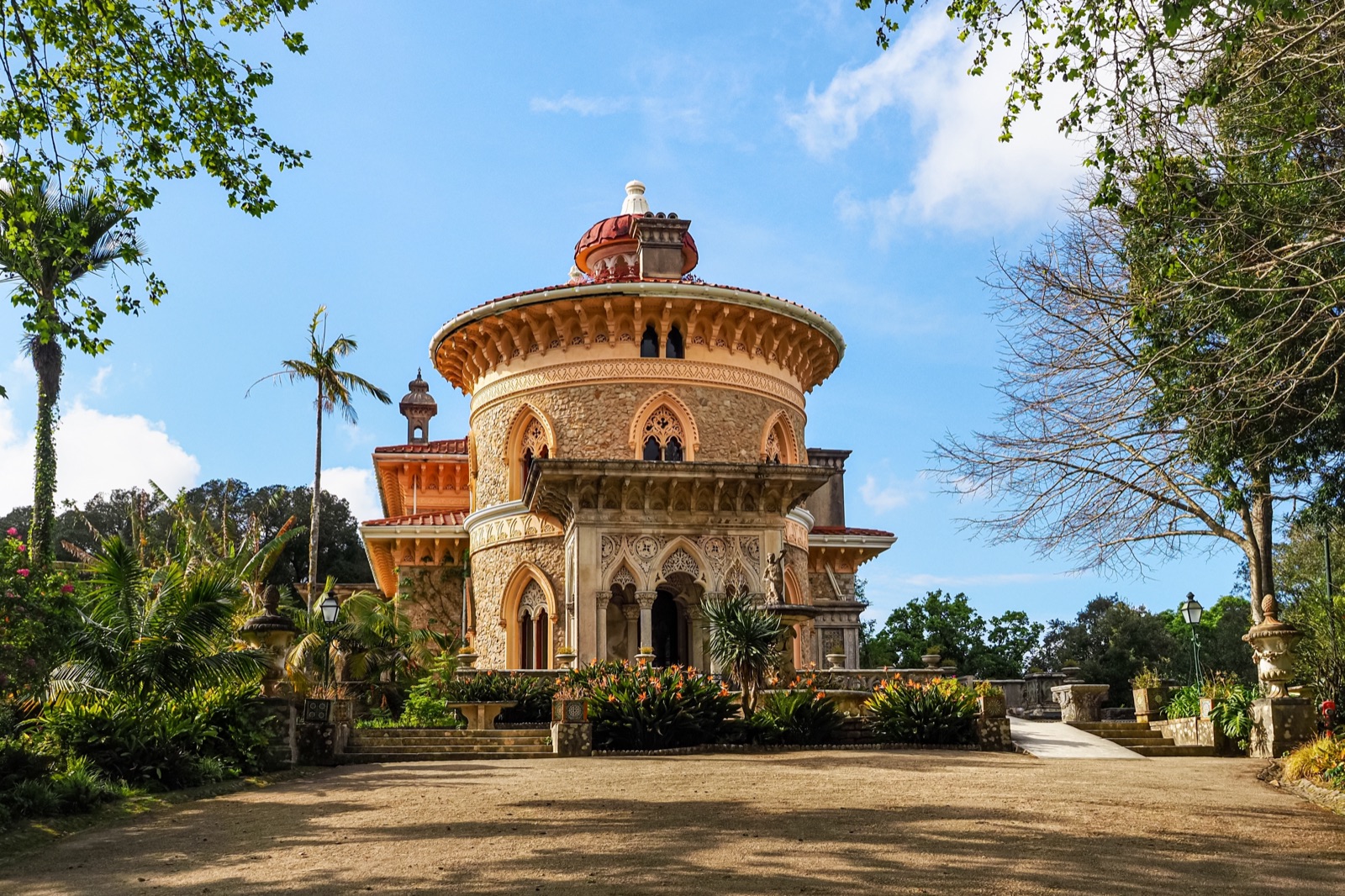
Monserrate is the palace on the western side of the Sintra hills whose domes and carved arches draw on the architecture of India, set in one of the finest botanical gardens in Portugal. It was built for Francis Cook, a British merchant and art collector who bought the estate in 1863, by the British architect James Knowles Junior. Before him came Gerard de Visme, a British merchant who built a Neo-Gothic house here after 1789, and the writer William Beckford, who rented the estate in 1794.
It is quieter than Pena and Regaleira. In 2025 it had 200,000 visitors, against 1.9 million at Pena, and the gardens are the reason to go as much as the palace. This article tells the story of the estate from its first hermitage to its restoration, explains what to look for inside the palace and in the park, and ends with the practical basics. For how Monserrate fits into a day with other sights, see Plan C in our guide to one day in Sintra.
Monserrate at a glance
- What it is: a 19th-century palace combining Gothic and Indian influences with Moorish touches, in a park of plants from all over the world.
- Built for: Francis Cook, who bought the estate in 1863; architect James Knowles Junior.
- Earlier tenants: Gerard de Visme from 1789, William Beckford from 1794.
- The park: more than 3,000 exotic species, planted after careful study of the estate’s microclimates, arranged by region of origin.
- Owned by the state: since 1949; managed by Parques de Sintra since 2000.
- World Heritage: part of the Cultural Landscape of Sintra, inscribed by UNESCO in 1995.
- Where: 4 km from Sintra’s historic centre, on the road to Colares.
From hermitage to earthquake ruin
The estate’s history starts in 1540, when Friar Gaspar Preto had a hermitage built here dedicated to Our Lady of Monserrate. He had travelled across the Iberian Peninsula and been struck by the hermitage of Montserrat, near Barcelona in Catalonia, and the name followed him home. The land then belonged to the Todos os Santos Hospital in Lisbon, of which Gaspar Preto was rector, and he meant it to serve as a workplace and as farmland producing food for the hospital.
In the 17th century the Mello e Castro family held the charter for the estate, and in 1718 it was acquired by Caetano de Mello e Castro, Commander of the Order of Christ and Viceroy of India. A connection to India, in other words, long before Cook’s architect borrowed its forms.
Then the great Lisbon earthquake of 1755 devastated the site, leaving a trail of destruction, and the estate was still in poor condition more than thirty years later.
Gerard de Visme’s Neo-Gothic castle
In 1789, with the estate still in poor condition, it was rented by Gerard de Visme, a British merchant. He had a Neo-Gothic castle built there, over the ruins of the old chapel, but lived in it for only a few years.
His house matters because it never entirely disappeared. Wikipedia’s account of the estate says that when Francis Cook bought Monserrate he and his architect worked on the remains of de Visme’s house, and Parques de Sintra confirms one direct survival: the octagonal shape of the palace’s central atrium already existed in the original house, built by de Visme and lived in by Beckford.
William Beckford’s tenancy
In 1794 the British writer William Beckford, author of the novel Vathek, became the tenant of Monserrate; Sintra’s tourism site says he sublet it from Gerard de Visme. He commissioned restoration and improvement works on the house and on the large gardens around it. He did not stay long: in 1799 he moved out, and the estate fell into neglect again, although his lease ran for another eight years.
Beckford left traces in the park that still carry his name. Beckford’s Waterfall is an artificial cascade attributed to him, and Sintra’s tourism site adds that he had dams built to keep a steady flow of water to it. Vathek’s Arch, a stone arch also attributed to Beckford, is named after the title character of his famous novel. If the attributions are right, both date from Beckford’s few years here, long before Cook’s plant collections.
Byron and the Romantic visitors
Even in decline, Monserrate drew foreign visitors, above all from Britain. Parques de Sintra calls it a retreat for writers, praised by British visitors in their travel accounts and engravings. The most famous was Lord Byron, the poet so closely linked with the Romantic movement, who visited in 1809, when the house was still a ruin, and wrote of his love for Monserrate in Childe Harold’s Pilgrimage.
Then came Francis Cook, a great art collector, whom Parques de Sintra’s history page calls a British trader and its main page a rich industrialist. When he visited Monserrate, the main page says, he was fascinated.
Francis Cook buys Monserrate
Cook first sublet the estate in 1856, and in 1863, after a long succession of owners, restorations and abandonments, he became its owner. He was made Viscount of Monserrate by King Luís I, the first to hold the title. Sir Francis Cook lived from 1817 to 1901, and the estate was the Cook family’s summer home: they spent their holidays there and gave large parties.
Cook was a major collector. In 2017 Parques de Sintra acquired a Renaissance marble relief of the Virgin and Child, attributed to Gregorio di Lorenzo, which had once been part of Cook’s collection at Monserrate, and brought it back to the palace.
James Knowles’s palace
Cook commissioned the palace from the British architect James Knowles Junior, and UNESCO describes the result as an example of mid-19th-century eclecticism, adapted to the remains of the earlier building and combining neo-Gothic forms with substantial elements drawn from the architecture of India. Parques de Sintra puts it as a palace combining Gothic and Indian influences with Moorish touches, and calls it a true ode to Romantic architecture, to Cook’s refined taste and to the genius of its architect.
The exterior and interior were designed as one. The exotic and foliage motifs of the interior decoration continue onto the outside of the building, and the grounds around it were reshaped at the same time into one of the finest botanical gardens in Portugal.
Inside the palace
The rooms are built around one idea: Monserrate was a summer house, and Parques de Sintra describes the flow between garden and interior as deliberately intensified.
- The Main Hall: the central atrium, an octagon that family and guests crossed on their way to the rest of the house, with the bedrooms on the floor above looking down from a landing. Water burbles in a central fountain, and light falls from the cupola onto the foliage carved into the walls. Parques de Sintra calls the octagon a reference to the Gothic period, inspired by the Founder’s Chapel at the Monastery of Batalha, a building that mattered to the British Gothic revival: like the rest of de Visme’s house, it is Neo-Gothic, not medieval.
- The Gallery: the corridor that links the rooms and towers, finished entirely in Moorish-patterned plaster in relief. A run of arches between the columns creates the perspective and lets in light from above. The same columns, arches and soft pink, orange and bluish tones repeat outside, and the whole house is decorated with leaves, stems, birds and flowers, as if the park had grown indoors.
- The Music Room: the main room for receiving guests, where music was the great entertainment of the Cooks’ summer afternoons and evenings. Its structure and decoration were designed around its acoustics, and music carries through the whole house. At the base of the cupola are busts of Apollo, the Muses and Saint Cecilia, patron saint of music, and concerts are still held there.
- The Dining Room: deliberately solemn, in contrast to the lighter Music Room and Sitting Room. A cloth awning once hung over the table, like a religious canopy or an oriental tent, to soften the echo of conversation, and dishes arrived from the kitchen on an internal service lift that still works.
- The Library: Cook’s working office, and later his descendants’, and the only main room that can be closed off with a solid door. The door is a work of art in itself, made of walnut and carved with Diana, goddess of hunting, and the bookcases keep the sober Neo-Renaissance style of the dining room.
- The Garden Entrance: the family’s own way in, placed at the centre of the house, as was common in British summer houses, so that guests could pass from the garden straight into the sitting, music and billiards rooms.
Parques de Sintra’s description of Cook’s Monserrate also mentions Indian panels in alabaster and a tiger skin in the atrium, and the restoration of the collection continues, with pieces such as the marble relief bought in 2017 returning to the house.
The park: plants from every continent
Monserrate’s park is the reason many visitors come. UNESCO says careful analysis of the estate’s microclimates made it possible to plant more than 3,000 exotic species collected from all over the world, and Sintra’s tourism site calls it one of the most important English gardens and landscapes outside the British Isles. The plants were arranged in geographical areas reflecting their origins, so that walking the paths between the ruins, lakes and waterfalls takes you from one part of the world to another.
The sources credit the design differently. Parques de Sintra names the landscape designer William Stockdale, the botanist William Neville and the master gardener James Burt, while UNESCO describes the gardens as largely the work of Thomas Gargill. Parques de Sintra adds that, above all, the park reflects Cook’s own Romantic spirit.
The exotic plants grow beside native ones: tree-sized arbutus, holly, now very rare, and cork oaks.
Five corners of the park to find
- The Mexican Garden: about 5,000 square metres in the park’s main valley, its warmest and driest area. Making it meant transforming the valley: the stream was diverted into a canal halfway up the south bank, and retaining walls created terraces, paths and a water system that took in two older tanks. It holds palms, yuccas, nolinas, agaves and cycads.
- Fern Valley: a notable collection of tree ferns from Australia and New Zealand, much prized in 19th-century Europe. To give them the conditions they need outdoors, they were planted in a north-west-facing valley exposed to the moist winds from the coast.
- The Japanese Garden: an exotic collection recreating an Asian atmosphere, with bamboos and camellias to the fore.
- The Rose Garden: probably among Cook’s first works. For him the rose was the Queen of Flowers, and his rose garden was strongly scented and meant to evoke the Far East. Fully restored, it reopened in 2011 with a collection of historical rose varieties.
- The Lawn: the first lawn planted in Portugal, a large surface with a double curve that needed an inventive irrigation system. At its foot, beside the lake that replaced an old weir, stands a Norfolk Island pine that is now the tallest tree in the garden, at over 50 metres.
Follies, ruins and borrowed monuments
Like other Romantic gardens, Monserrate has its staged ruins and souvenirs.
- The Chapel: a false ruin designed by Francis Cook out of the chapel that Gerard de Visme had built to replace the old Chapel of Our Lady of Monserrate. Overgrown, it is now bound up with the Australian rubber tree beside it. Its niche once held three Etruscan sarcophagi used as garden ornaments, which are now in the São Miguel de Odrinhas Archaeological Museum in Sintra.
- The Indian Arch: an ornamental arch that Cook acquired from Charles Canning, Governor-General of India, after the Indian Rebellion of 1857.
- Beckford’s Waterfall and Vathek’s Arch, described above, from the estate’s earlier life.
From private estate to public monument
The Portuguese state bought the estate and the palace in 1949, and a few years later the Park and Palace of Monserrate were classified as a Property of Public Interest. In 1995 they became part of the Cultural Landscape of Sintra, inscribed by UNESCO as World Heritage.
When Parques de Sintra took over the management in 2000, the palace needed a thorough intervention: the rehabilitation of all the roofs and facades and new infrastructure networks, which allowed the palace to reopen in 2010. The interiors were then restored in full view of visitors until 2016, and work continues on the museum collection, with pieces acquired to evoke both Cook’s art collections and the family’s daily life. Since 2020 the park and palace have been part of the European Route of Historic Gardens, one of the Council of Europe’s Cultural Routes.
Visiting Monserrate today
Practical details, as listed by Parques de Sintra in October 2026. Our guide to Sintra’s palaces and tickets compares them with the other sights.
- Tickets: park and palace together, €12 for adults, €10 for youths (6–17) and seniors (over 65), €33 for a family of two adults and two youths. Buying Monserrate in one purchase with other Parques de Sintra sites brings a discount.
- Hours: the park opens 9:00–19:00 (last ticket 17:30, last admission 18:00); the palace 9:30–18:00 (last ticket 17:00, last admission 17:30). The ticket office closes from 12 pm to 1 pm, with ticket machines available.
- Works: restoration of the palace roofs runs until the first quarter of 2027, with scaffolding and a temporary cover on the building. The palace stays open, but the exterior will look different in photographs.
- Getting around: the electric hop-on hop-off service in the park is temporarily out of service, so plan to walk.
- Dogs are welcome in the park.
- Getting there: Scotturb bus 435 and Carris Metropolitana bus 1253 run from Sintra station. By car, the park is on the EN375 between Sintra and Colares, and because of roadworks the park’s own site recommends approaching via Colares.
Guided visits: Parques de Sintra runs a 1h30 guided visit of the park and palace, in Portuguese or English, meeting at the ticket office. As listed in October 2026 it costs €17 for adults, €15 for youths and seniors and €53 for a family, with entry included; times are on the online ticket office, and the route is not accessible to visitors with reduced mobility.
Because the park opens half an hour before the palace and closes an hour later, the comfortable order is the gardens first, then the palace in the middle of the day, then the rest of the park if you still have the legs. Allow at least a couple of hours plus the bus. If you are pairing it with another sight, our guide to one day in Sintra sets out a quieter western day built around Monserrate, and the guides to Pena Palace and Quinta da Regaleira cover those two sights in detail.
Frequently asked questions
Who built Monserrate Palace?
The palace was built for the British merchant and art collector Francis Cook, who bought the estate in 1863, to designs by the British architect James Knowles Junior. It stands on the remains of a Neo-Gothic house built by Gerard de Visme, who rented the estate in 1789.
What style is Monserrate Palace?
It is mid-19th-century eclectic: UNESCO describes neo-Gothic architecture with substantial elements derived from the architecture of India, and Parques de Sintra adds Moorish touches. The carved, foliage-like decoration runs from the interior to the exterior.
Did Lord Byron stay at Monserrate?
He visited and praised it: Parques de Sintra notes that Byron expressed his love for Monserrate in Childe Harold’s Pilgrimage. The writer who actually rented the estate was William Beckford, from 1794.
How many plants are there in Monserrate’s gardens?
UNESCO says careful study of the estate’s microclimates made it possible to plant more than 3,000 exotic species from all over the world, arranged by region of origin.
Is Monserrate worth visiting?
Yes, especially if you like gardens or want to avoid crowds. It had 200,000 visitors in 2025, against 1.9 million at Pena, and the park deserves as much time as the palace.
How do you get to Monserrate from Sintra?
By Scotturb bus 435 or Carris Metropolitana bus 1253 from Sintra station. By car, the park’s own site recommends approaching via Colares because of roadworks.