Places
Cabo da Roca and Sintra's Beaches: Ursa, Adraga, Praia Grande and Azenhas do Mar
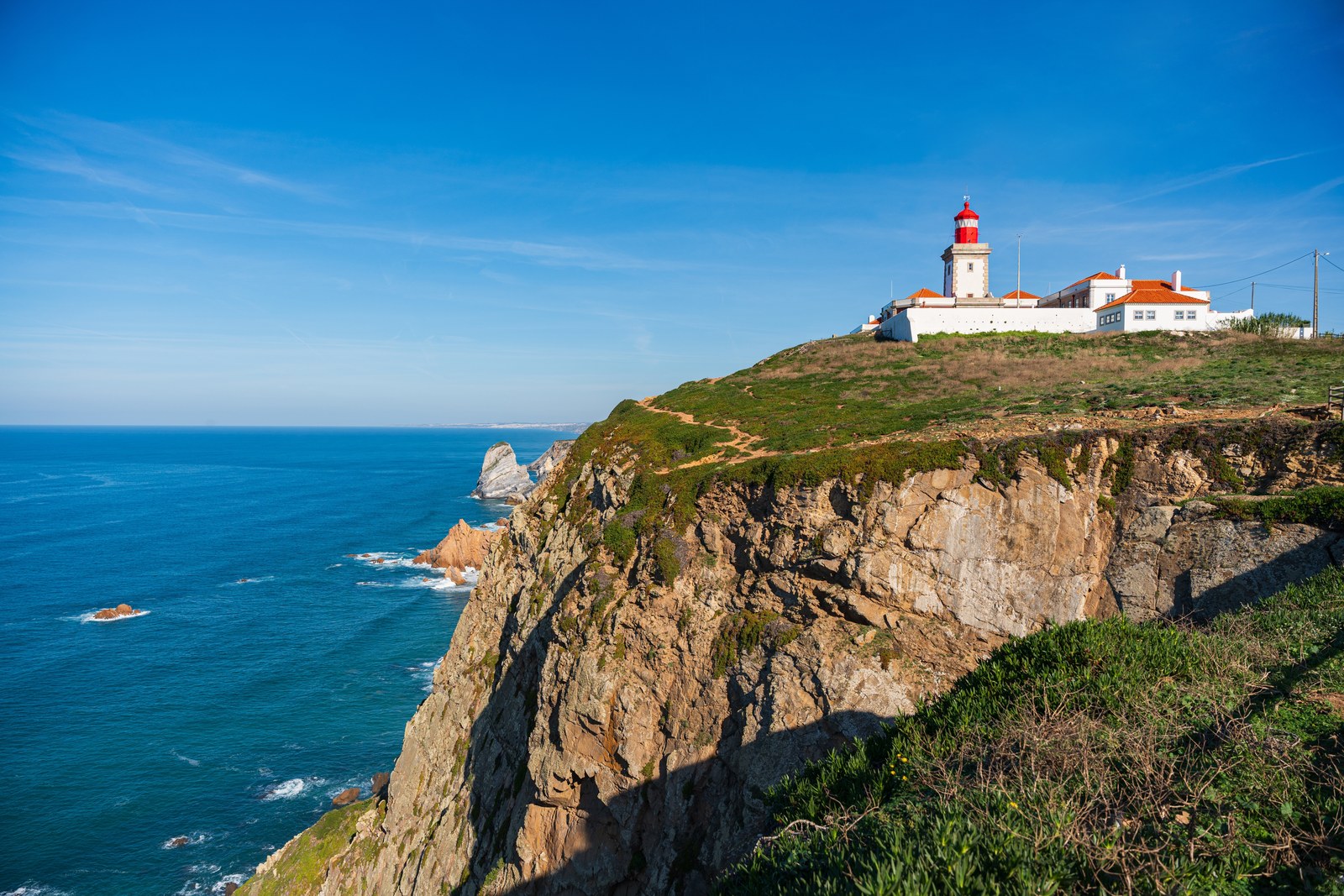
West of the Sintra hills, the land runs out at Cabo da Roca, the westernmost point of mainland Europe, a headland with a red-and-white lighthouse first ordered in 1758. North of it, the cliffs open onto a string of beaches: Praia da Ursa, a wild cove that has never been classified for bathing; Adraga, a sandy beach between cliffs; Praia Grande, the largest beach on the Sintra coast; and Azenhas do Mar, a village built down a cliff above a small beach and an ocean pool.
All of them can be reached from Sintra by bus, some with a walk at the end, and all of them sit on the open Atlantic, which shapes what you can safely do there. This article goes through each place in turn: how you get there, what it is like, what there is to see and how swimming works, including the lifeguard season, which in 2026 ran from 30 May to 13 September at the Sintra beaches covered here. For the rocks, plants and trails of this coast, see our article on the Sintra-Cascais Natural Park; this one is about visiting.
The coast at a glance
- Cabo da Roca: the most westerly point of mainland Europe, with a lighthouse, the Camões cross and a ticketed lighthouse visit. Bus 1253 from Sintra station, bus 1624 from Cascais.
- Praia da Ursa: an isolated cove with difficult access between Cabo da Roca and Adraga. Not a bathing water and never lifeguarded.
- Praia da Adraga: a golden beach under cliffs, with the Fojo and the Pedra de Alvidrar nearby. Lifeguarded in season.
- Praia Grande: the largest beach on the Sintra coast, a surf and bodyboard venue, with dinosaur footprints on its southern cliff. Buses 1250 and 1254.
- Azenhas do Mar: a cliff village with a viewpoint, a small beach and an ocean pool. Bus 1254, or a walk along the coast from Praia das Maçãs.
- Lifeguard season 2026: 30 May to 13 September at Adraga, Praia Grande, Praia das Maçãs and Azenhas do Mar.
Cabo da Roca: where the land ends
Parques de Sintra, which manages the lighthouse, describes Cabo da Roca as the most westerly point on mainland Europe, with an unrivalled view over the Atlantic. Sintra’s municipal tourism site puts it at the far end of the Sintra hills and notes its changeable moods: sometimes shrouded in fog, sometimes in full sun.
Near the lighthouse stands a cross with a homage to Luís de Camões, whose epic poem The Lusiads, in Canto III, describes Portugal as the place “where the earth ends and the sea begins”. Parques de Sintra explains that this position at the edge of the known world made Cabo da Roca a sacred and legendary place.
Visitors can also buy a certificate of their visit to the westernmost point of the continent from the local tourism office at the cape.
The headland is high and exposed. The long-term figures from IPMA, Portugal’s weather service, show a place that stays cool in summer and mild in winter. Our article on Sintra weather sets out those numbers; the point for a visit is that the cape is exposed, cool in summer, and can be in cloud when Lisbon is in sun. Bring a layer even in August.
The lighthouse
The Cabo da Roca lighthouse stands 165 metres above sea level and is 22 metres tall, its tower finished in white tiles with a red walkway. It was one of six lighthouses ordered by the Marquis of Pombal’s charter of 1 February 1758, and Parques de Sintra’s pages date the start of its operation, or of the works, to 1772. They also rank it differently: the main page calls it the second oldest on the Portuguese coast, the history page the third oldest still in operation. Either way, it is one of the oldest.
Its history is a short course in lighthouse technology:
- 1843: a new rotating apparatus with sixteen Argand lamps and parabolic reflectors.
- 1883 to 1897: an electric light and a steam fog signal were approved in 1883 and went into service in 1897.
- 1937: a radio beacon.
- 1980: mains electricity finally arrived.
- 1990: the light was automated.
- 2017: the General Directorate of the Maritime Authority and Parques de Sintra agreed to manage the site together, the arrangement behind today’s visits.
Parques de Sintra now runs visits there, with two tickets and one set of hours, as listed in October 2026:
- Essential Visit: €5 for adults, seniors and youths alike, €15 for a family of two adults and two youths, free for children under 6.
- Panoramic Visit: €10 for adults, €7.50 for seniors, €5 for youths and €20 for a family; free for children under 6. Parques de Sintra presents it as the option for sweeping views over the Atlantic coast.
- Hours: the courtyard and interpretation space open 9:30–17:30.
You do not need a ticket to stand on the headland, look at the cross or watch the sea. The tickets are for the lighthouse itself. Check current prices and what each visit includes before you go.
Getting to Cabo da Roca
- From Sintra by bus: Carris Metropolitana bus 1253 runs from Sintra station to Cabo da Roca. It is a circular line, so the same bus brings you back to the station, passing Monserrate on the way.
- From Cascais by bus: bus 1624 links the Cascais bus terminal and Portela de Sintra via Azóia and Almoçageme, with a stop at Cabo da Roca.
- By car: the EN-247 reaches the cape from Cascais or from Colares.
- On foot: several marked footpaths lead to Cabo da Roca from Cascais, Colares and the Sintra hills, and the cape is the start of the PR7 circular walk of about 13.2 km along the cliffs to Adraga and Praia Grande.
Our guide to getting to Sintra from Lisbon covers the train and the buses from Sintra station.
Praia da Ursa: the wild cove below the cape
Just north of Cabo da Roca, under the cliffs, lies Praia da Ursa. The facts about it are sobering, and they come from Portugal’s environment agency, the APA.
The APA describes Ursa as an isolated beach with difficult access, between Adraga and Cabo da Roca. It has never been suitable for bathing, and so it is classified neither as a bathing water nor as a bathing beach. That means it has no beach plan and no lifeguards. The agency’s note was written after a rockfall on the beach on 15 March 2018 killed one person and injured another.
What this means in practice:
- Access is on foot, down the cliff. The APA calls it difficult, and the climb back up is the hard part.
- The nearest bus stop is the one Carris Metropolitana calls “Estr do Cabo da Roca (X) Ursa”, the Ursa junction on the road to the cape, served by buses 1253 and 1624.
- Do not swim there. It is not a bathing water, and if something goes wrong, help is a long way off.
- Keep away from the foot of the cliffs. The 2018 accident was a rockfall.
- Avoid it in rain, fog or failing light, and wear proper shoes rather than sandals.
If you want the scenery without the risk, the cape itself looks out over this stretch of coast.
Praia da Adraga
Adraga is the next beach north and a complete contrast. Sintra’s tourism site describes it as known for pure water and easy access to its wide golden beach, with cliffs on either side. Dark rocks scattered across the sand give it a character of its own, and outside the bathing season it is a place for a walk, or for exploring the caves.
Its water quality has been recognised: in 2019, for the third year running, Adraga received the Golden Quality Beach distinction from Quercus, the Portuguese nature conservation association, which rated its quality as excellent.
Two curiosities sit beside the beach, both described in more detail in our natural park article:
- The Fojo: a natural well about 90 metres deep, roughly fifty metres back from the cliff, which connects with the sea. It was formed by rainwater dissolving the limestone along fractures, helped by the waves. The Romans are said to have believed that a Triton blew a conch at its bottom, and a delegation was reportedly sent to the emperor Tiberius to report the noise, which was probably the waves.
- The Pedra de Alvidrar: a huge rock on the southern side that drops almost vertically into the sea, which local tradition says young men climbed to prove their courage. Look at it; do not try it.
Getting there: no Carris Metropolitana stop carries Adraga’s name, so you either drive down to the beach or walk from the village of Almoçageme, inland, whose market stop, Almoçageme (Mercado), is served by lines 1241, 1242, 1250 and 1624. The PR7 cliff walk from Cabo da Roca also passes Adraga.
Swimming: in 2026 Adraga was a lifeguarded bathing beach from 30 May to 13 September.
Praia Grande
Praia Grande, as the name says, is the largest beach on the Sintra coast: an expanse of white sand backed by cliffs, which Visit Sintra describes as enjoyable at any time of the year. It is also one of the favourite places in the world for surfing and bodyboarding, and it hosts major events, such as the World Bodyboard Championship in August.
The beach has one sight that has nothing to do with the sea. Its southern cliff is marked by large schist blocks set at right angles to the coastline, and a staircase climbs up it to sixty-six dinosaur footprints, which Sintra’s tourism site dates to 170 million years ago. Portugal’s nature conservation institute, the ICNF, gives 160 million years for the oldest rocks visible in the natural park, so the two sources do not agree on the age. At the top, you get a view over the whole beach and the coast. Keep to the staircase rather than scrambling on the cliff.
Getting there: Carris Metropolitana’s line 1250 runs from Portela de Sintra station (Estação Norte) to Praia Grande, and line 1254, which also starts at Portela de Sintra, stops at Praia Grande on its way along the coast to Magoito. Check the timetables before you go, especially out of season.
Swimming: in 2026 Praia Grande was a lifeguarded bathing beach from 30 May to 13 September. Surfers and swimmers share the water, so stay in the area the lifeguards mark for bathing.
Praia das Maçãs and the Sintra tram
Praia das Maçãs, just north of Praia Grande, is the easiest of these beaches to reach without a car, because it is the end of the line for the Sintra tram. First run in 1904, the tram covers almost 11 km from Vila Alda, on the edge of Sintra, through vineyards and orchards to the beach, in about 45 minutes, with tickets bought on board. Visit Sintra notes that there is no shortage of restaurants serving fish and seafood in the village.
In 2026 Praia das Maçãs was a lifeguarded bathing beach from 30 May to 13 September. It is also the natural starting point for a walk to Azenhas do Mar. Check the tram’s timetable on Visit Sintra, the municipality’s tourism site, before planning around it.
Azenhas do Mar
Azenhas do Mar is a cliff village: a cluster of houses built down the rock face above the sea. The village stretches along a stream flowing into the ocean and is named after the water mills, or azenhas, that once stood there. Sintra’s tourism site describes houses cascading down the cliff to the sea, and a viewpoint built on the cliffs beside small blue-edged houses, high above the water breaking on the rock below.
At the foot of the cliffs are a small beach and an ocean pool, which makes it one of the most sought-after spots for bathers on this coast. The beach really is small: Visit Sintra says there is no more than 30 metres of sand, and it can disappear completely at high tide, so check the tide before you go down. Treat the pool with the same care as the open sea when the swell is up.
Over recent decades the former fishing village has become a summer retreat, and an inspiration for painters such as Júlio Pomar and Milly Possoz.
Getting there: the easiest way is to walk. From Praia das Maçãs a 20-minute walk along the coast brings you to the Azenhas do Mar viewpoint. By bus, Carris Metropolitana line 1254 stops at “Parque de Campismo (Azenhas do Mar)”, the campsite stop near the village.
Swimming: in 2026 Azenhas do Mar was a lifeguarded bathing beach from 30 May to 13 September.
Swimming on the open Atlantic
This coast faces the open ocean. Its beaches can have strong currents and big surf, and the same sea that makes Praia Grande a surfing venue makes it hard work for swimmers.
How lifeguard cover works in Portugal:
- A government order fixes the season each year. For 2026, Portaria n.º 204-A/2026/1 of 30 April identified the bathing waters, set the dates of each one’s bathing season and named the beaches where lifeguards are on duty.
- Sintra’s 2026 season ran from 30 May to 13 September at Adraga, Azenhas do Mar, Praia Grande and Praia das Maçãs, as well as at Magoito and São Julião further north.
- Lifeguards are assured only during each beach’s season. Outside those dates, assume there are none.
- Ursa is not on the list at all, because it has never been a bathing water.
Sensible rules follow from that. Swim only at a lifeguarded beach during its season, inside the area the lifeguards mark, and follow their flags and whistles. Never swim alone, near rocks or near surfers. Stay away from the base of the cliffs, where rock falls happen, and from cliff edges above. The emergency number in Portugal is 112. The 2027 dates will be set by next year’s order, so check them before you plan a beach day.
A coast day from Sintra
The buses make several good combinations possible without a car:
- Cape and Cascais: bus 1253 from Sintra station to Cabo da Roca, then bus 1624 on to the Cascais bus terminal, and from Cascais the train back to Lisbon. Our guide to one day in Sintra explains how this joins onto a morning at the palaces.
- Tram and cliffs: the tram from Sintra to Praia das Maçãs, a walk along the coast to Azenhas do Mar, and bus 1254 back to Portela de Sintra.
- Beaches and footprints: line 1250 to Praia Grande for the dinosaur staircase and the beach, then line 1254 or the coast path on to Praia das Maçãs.
- On foot: the PR7 from Cabo da Roca along the cliffs to Adraga and Praia Grande, for anyone happy with a walk of about 13.2 km.
Do not try to add the coast to a day that already includes Pena and another palace; our Pena Palace guide explains why the timed palace slot shapes the whole day, and the guide to Sintra’s palaces and tickets compares the sights.
Tours that include the coast
If you would rather not juggle bus timetables, several tours fold the coast into a day:
- The classic day tour from Lisbon runs about 9 hours and covers Pena Palace and its gardens, Quinta da Regaleira and its Initiation Well, the cliffs at Cabo da Roca and the Cascais waterfront.
- A private 8-hour day by car takes in the Estoril coast and Cascais and the clifftop at Cabo da Roca, then Sintra’s historic centre with Pena Palace and the National Palace.
- A private 4-hour classic car or electric jeep tour, if you are already in Sintra, is customisable and can take in the cliffs and beaches of the Atlantic coast as well as the palaces and mountain roads.
None of them is sold as a beach day, so check how much time each allows on the coast. Our tours page compares them.
Frequently asked questions
Is Cabo da Roca worth visiting?
Yes, if you value the setting more than a sight. It is the westernmost point of mainland Europe, with the Camões cross, the lighthouse and wide Atlantic views. Allow time for the bus, and bring a warm layer: the cape is exposed and often in fog.
How do I get from Sintra to Cabo da Roca by bus?
Take Carris Metropolitana bus 1253 from Sintra station; it is a circular line that serves Cabo da Roca and returns to the station. Bus 1624 links the cape with the Cascais bus terminal.
Can you swim at Praia da Ursa?
It is strongly discouraged. Portugal’s environment agency says Ursa has never been suitable for bathing and is not classified as a bathing water or a bathing beach, so there are no lifeguards, and access on foot down the cliff is difficult. A rockfall there killed one person in 2018.
When are Sintra’s beaches lifeguarded?
In 2026, the bathing season at Adraga, Praia Grande, Praia das Maçãs and Azenhas do Mar ran from 30 May to 13 September. The dates are set each year by government order, so check the current year’s dates before you go.
Where are the dinosaur footprints near Sintra?
On the southern cliff of Praia Grande. A staircase climbs to sixty-six footprints that Sintra’s tourism site dates to 170 million years ago, with a view over the beach from the top.
Can I visit the Cabo da Roca lighthouse?
Yes. Parques de Sintra runs an Essential Visit (€5 for adults) and a Panoramic Visit (€10 for adults), with the courtyard and interpretation space open 9:30–17:30. The headland itself is open ground and free.