Practical
Sintra Weather: Why It Is Cooler and Foggier Than Lisbon, by Season
Sintra’s weather is mild all year, but it is cooler, damper and much foggier than Lisbon’s, even though the two are close neighbours. The long-term averages published by IPMA, Portugal’s weather institute, for the Sintra air base station put the average daily high at 14.3 °C in January and 25.3 °C in August, against 27.8 °C in Lisbon in August. The same records count 32 days of fog a year in Sintra and 13.5 in Lisbon, and 767.7 mm of rain a year, most of it between October and April.
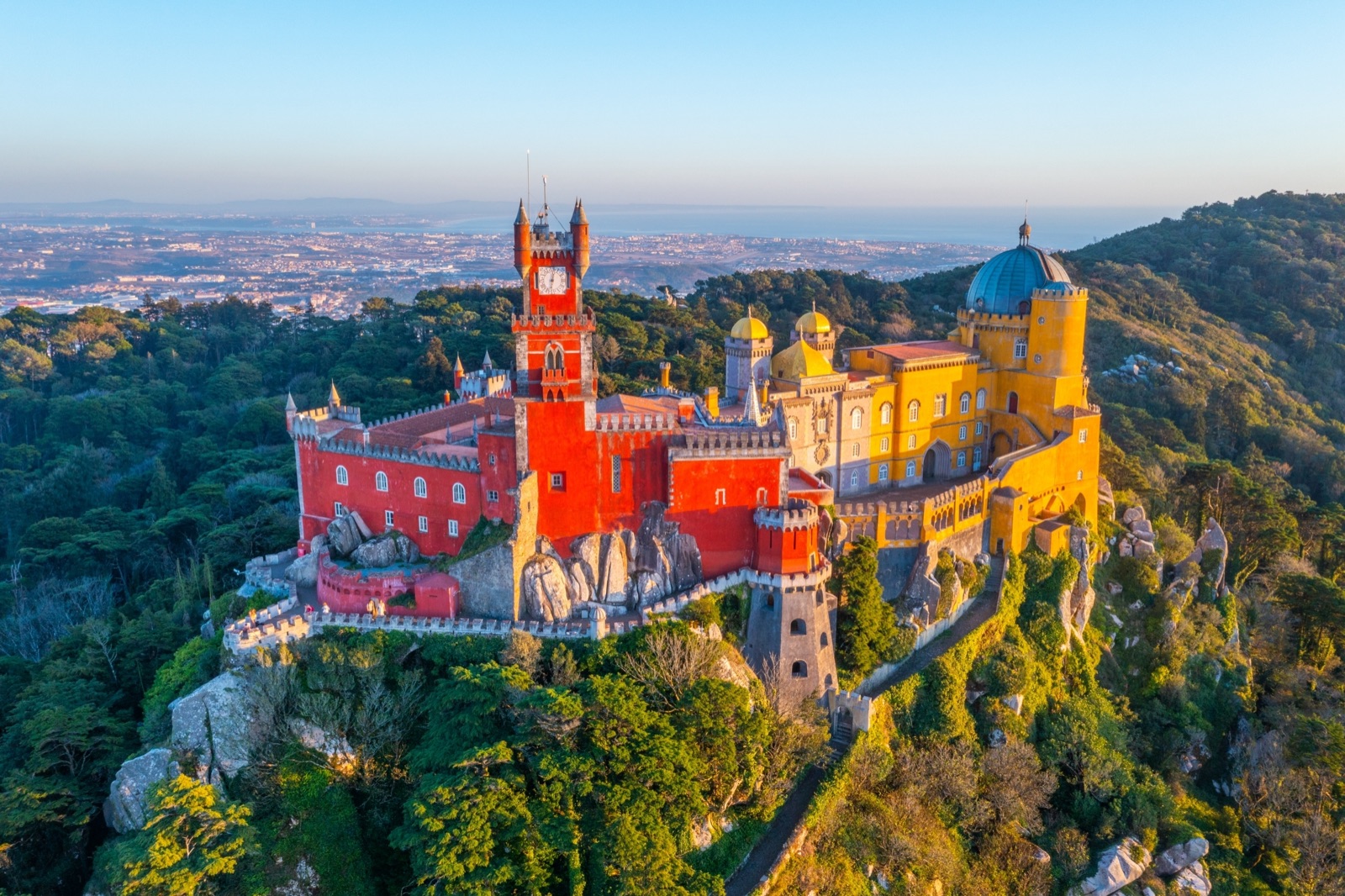
Up on the hills, where Pena Palace, the Moorish Castle and the parks stand, it is mistier still. Parques de Sintra, which runs most of the palaces, says the hills act as a barrier that forces sea air upwards until it condenses, which is why mornings so often start with drizzle and cloud. The practical answer for a visit is simple: take a warm layer and a waterproof in any month, expect morning mist, and plan the best viewpoints for the afternoon, when the weather often clears.
Sintra weather at a glance
- Warmest month: August, with an average high of 25.3 °C and an average low of 15.6 °C at the Sintra air base.
- Coolest month: January, with an average high of 14.3 °C and an average low of 5.2 °C.
- Wettest months: December (127.8 mm) and November (111.5 mm).
- Driest months: July (6.2 mm) and August (6.9 mm).
- Fog: 32 days a year on average, spread across every month; Lisbon averages 13.5.
- Frost and snow: 7.9 nights a year at or below 0 °C on average, and no days of snow in the records.
- Sunshine: 2,607 hours a year, from about 129 hours in December to about 309 in July.
All of these figures are IPMA’s climate normals for 1971–2000, thirty-year averages rather than a forecast. They describe what is typical, not what any given week will bring.
Why Sintra makes its own weather
Sintra sits at the far western edge of the Iberian Peninsula, a few kilometres from the Atlantic, at the foot of a small range of forested granite hills, the Serra de Sintra. The ICNF, the institute that manages the surrounding Sintra-Cascais Natural Park, describes the Serra as a ridge running from east to west that forms a natural barrier against sea winds. The Serra is also known as Monte da Lua, the Mountain of the Moon, and its highest point, the High Cross in Pena Park, stands at 528 metres.
Parques de Sintra explains what happens next. Nearness to the ocean plays a part, but the most important factor is the role of the hills as an orographic barrier. When air masses coming from the sea and from the north meet the hills, they are forced to rise, and rising air cools and condenses into cloud, fog and drizzle. In the afternoon, as temperatures climb, the air reaching the hills is less cold, the contrast is softer, and the cloud often lifts.
The result is a pocket of humid, green, misty country right next to a capital city known for sunshine. The ICNF links the high humidity and varied soils directly to the Serra’s unusually rich vegetation, and Parques de Sintra notes that more than 340 species of trees have been identified in Pena Park alone. The fog and the forest feed each other: the trees help keep the soil moist and the air humid, and the humidity keeps the trees growing.
A note on where the numbers come from
IPMA’s Sintra figures come from the air base station, at 134 m above sea level, far below the High Cross (528 metres) and the Sanctuary of Peninha (488 metres). On the hilltops, expect conditions to be cooler, cloudier and windier than the table below suggests. Lisbon’s figures come from the Instituto Geofísico station, at 77 m.
Sintra and Lisbon compared
The table sets the two stations side by side over the same thirty years.
| Average (1971–2000) | Sintra air base | Lisbon, Instituto Geofísico |
|---|---|---|
| Daily high, January | 14.3 °C | 14.5 °C |
| Daily high, August | 25.3 °C | 27.8 °C |
| Daily low, January | 5.2 °C | 8.1 °C |
| Daily low, August | 15.6 °C | 18.1 °C |
| Mean temperature, year | 14.9 °C | 17.0 °C |
| Rain, year | 767.7 mm | 725.8 mm |
| Days of fog, year | 32 | 13.5 |
| Days reaching 25 °C | 49.8 | 92.2 |
| Days reaching 30 °C | 13.3 | 24.8 |
| Humidity at 09:00 UTC, year | 81% | 76% |
Two things stand out. In winter the daytime highs are almost identical, but Sintra’s nights are about three degrees colder, and it gets frost on 7.9 nights a year while Lisbon’s station records none. In summer the gap opens in the afternoons: Lisbon reaches 25 °C on 92.2 days a year and Sintra on 49.8. If Lisbon feels too hot in July or August, Sintra is the obvious place to cool down.
The fog: Sintra’s famous “helmet”
Fog is the part of Sintra’s weather that visitors remember. Parques de Sintra calls rain and fog two of the town’s hallmarks and describes the fog “helmet” that forms over the hills and the beaches. It also describes Pena Park as frequently hidden under the veil of mist that characterises the Sintra hills, and the story of Quinta da Regaleira notes that the foothills are often shrouded in fog, which gives the estate its air of mystery.
The station records make the point well. The Sintra air base averages fog on 32 days a year, and on more than one day in every single month:
- Autumn is the foggiest season, with 3.3 days in September, 3.7 in October and 3.6 in November.
- Winter stays close behind, with 3.1 days in December and 2.9 in January.
- Summer still has fog, with 1.8 days in July and 2.4 in August, while Lisbon averages 0.1 days in July and 0.2 in August.
That summer contrast is the one visitors notice. It is common to leave a bright, hot Lisbon in the morning and arrive in Sintra to find the hills in cloud. Locals have a saying for the summer months, that the weather “will clear up after lunch”, and Parques de Sintra explains why it so often does: as the day warms, the air arriving at the hills is less cold and condenses less. Remember, too, that these are station figures from lower ground; on the hills themselves, mist is more frequent.
Fog is not all bad news. Parques de Sintra suggests a walk in Pena Park on a foggy day for anyone who likes cooler weather, and the mossy gardens and towers look their most romantic when half hidden. The cost is the view: from the Pena terraces, the castle walls and the High Cross you may see nothing but white.
Rain: when it falls and how much
Sintra’s air base averages 767.7 mm of rain a year, a little more than Lisbon’s 725.8 mm. The pattern is classic Atlantic Portugal, wet in the cooler half of the year and almost dry in high summer.
| Month | Rain at Sintra air base | Days with at least 1 mm |
|---|---|---|
| October | 91.0 mm | 8.6 |
| November | 111.5 mm | 9.8 |
| December | 127.8 mm | 12.7 |
| January | 100.7 mm | 11.1 |
| April | 72.3 mm | 9.5 |
| July | 6.2 mm | 1.1 |
| August | 6.9 mm | 1.2 |
Over a year there are 86.6 days with at least 1 mm of rain. April is worth noting: with 72.3 mm on average, it is wetter than March (57.2 mm) or May (56.8 mm), so spring visitors should not assume settled weather. Parques de Sintra adds that, whatever the season, the morning in Sintra often starts with drizzle.
Rain also varies from place to place. The municipality of Sintra covers over 300 square kilometres, with more than 380 thousand inhabitants in 11 parishes, and Parques de Sintra points out that the rainy scenario is not felt in the same way everywhere. A wet morning in the historic town does not always mean a wet day on the coast, or the other way round. And for all the rain, the air base still averages 2,607 hours of sunshine a year.
Spring: March to May
Spring brings average highs of 16.8 °C in March, 17.4 °C in April and 19.2 °C in May, with nights between 7.3 °C and 10.6 °C. It is green and fresh, and good weather for walking between the palaces or on the hill trails. It is also changeable: April is one of the wetter months, and fog turns up on around two days a month. Pack a waterproof and a fleece and you will be comfortable.
Summer: June to September
Summer is when Sintra earns its reputation as Lisbon’s cool retreat. Average highs at the air base are 22.3 °C in June, 24.7 °C in July, 25.3 °C in August and 24.5 °C in September, with nights around 13.3 °C to 15.6 °C. Hot days do happen: the station averages 13.3 days a year reaching 30 °C, and the highest temperature in its thirty-year record is 41.4 °C, on 13 June 1981.
Summer brings two other things to know about:
- Morning mist. Fog is less frequent than in autumn, but it does form, especially over the hills and the coast, and it usually burns off by early afternoon.
- Fire risk. Hot, dry weather raises the risk of forest fire. Parques de Sintra, which manages the World Heritage site, cleans the forest areas every year to prevent fire in the hot season, and warns that some of its parks and monuments may close occasionally when access to the forest is restricted because of fire risk or extreme weather. A monument on the Capuchos trail remembers the soldiers who died fighting the great fire of 1966.
On the coast, summer is the season for the beaches. Praia Grande hosts major surfing and bodyboarding events, including the World Bodyboard Championship in August.
Autumn: October and November
Autumn starts warm and turns wet. October still averages a high of 21.1 °C, and November 17.5 °C, but rain returns in earnest, with 91.0 mm in October and 111.5 mm in November. These are also the foggiest months at the station, with 3.7 and 3.6 days of fog on average. Autumn light can be beautiful between the showers, and the parks, with their exotic trees, are at their most atmospheric.
Winter: December to February
Winter in Sintra is mild by northern European standards and damp. Average highs are 15.1 °C in December, 14.3 °C in January and 14.9 °C in February, with lows of 5.2 °C to 6.8 °C. Humidity at 09:00 UTC averages 87% in December and January. Frost is possible on lower ground, with 3.6 frosty nights on average in January, but the records show no snow.
December is the wettest month, with 127.8 mm of rain on average. On the trails, especially in winter, the footing on mountain paths can be varied and less stable, so wear proper shoes. The season has its own reward: Ferdinand II introduced Asian camellias to Pena Park in the 1840s, and they have become a landmark of the Sintra winter.
The coast is another climate again
The Atlantic coast below the hills has its own pattern, cooler in summer and milder in winter. IPMA’s 1981–2010 normals for Cabo da Roca, the westernmost point of mainland Europe, give an average high of 14.2 °C in January, 21.0 °C in July and 21.8 °C in August, and an average low of 9.8 °C in January. Days reaching 25 °C average only 18.2 a year there, and rain averages 538.1 mm. These are a different thirty-year period from the Sintra and Lisbon figures, so compare them loosely, but the message is clear: the sea keeps the cape cool in summer and mild in winter, with January nights more than four degrees warmer than at the air base.
Wind is part of the coastal picture too. Sintra’s walking trails on the southern side of the hills are described as more sheltered from the area’s characteristic north winds, and the municipality’s tourism site describes Cabo da Roca as sometimes shrouded in fog and sometimes bathed in sun. Our article on the Sintra-Cascais Natural Park covers the coast, the cliffs and the trails in more detail.
How the weather shapes a day in Sintra
A few habits make a Sintra day work in any weather:
- Do the views in the afternoon. The Pena terraces, the Moorish Castle walls and the High Cross are at their best once the morning cloud has lifted.
- Do the gardens and interiors in the mist. Pena Park, Monserrate and Quinta da Regaleira are atmospheric in fog, and the palace interiors do not care about the weather.
- Watch your footing. Stone steps, cobbles and woodland paths stay damp in Sintra’s humid air, especially after rain.
- Check for closures. Parques de Sintra’s parks open every day except 24, 25 and 31 December and 1 January, but may close in extreme weather.
For a full plan of how to fit the palaces, the walks and the coast into one day, see our guide to one day in Sintra. Our guide to Sintra’s palaces and tickets explains timed entry and how long each site needs, which matters if you are trying to time a viewpoint for clear weather. If the weather decides you would rather go with a guide, a day tour from Lisbon handles the transport while you watch the sky.
What to wear and pack
- A warm layer, all year. Even in August the air base averages a low of 15.6 °C, and the hilltops are cooler.
- A light waterproof. Drizzle and showers are possible in any month; from October to April they are likely.
- Shoes with grip. Paths, steps and cobbles are often damp, and the gardens are steep.
- Sun protection in summer. Bright afternoons follow misty mornings, and July averages about 309 hours of sunshine.
- Warmer clothes in winter. January nights average 5.2 °C at the air base, and frost is possible on lower ground.
Checking the forecast before you go
The averages in this article describe Sintra’s climate, not tomorrow’s weather. Check the forecast for Sintra from IPMA, or your usual weather app, the day before you travel, and look again in the morning. In summer, check Parques de Sintra’s notices for closures linked to fire risk, and in stormy weather check whether parks are open before you set off. Conditions can change within hours on the hills, so check before you go and pack for both sun and mist. If you are still deciding how to travel out from the city, our guide to getting to Sintra from Lisbon compares the options.
Frequently asked questions
What is the weather like in Sintra?
Mild all year, but cooler, damper and foggier than Lisbon. IPMA’s averages for the Sintra air base run from a high of 14.3 °C in January to 25.3 °C in August, with 767.7 mm of rain a year and fog on 32 days. The hills above the town, where the palaces are, are mistier still.
Is Sintra colder than Lisbon?
Yes, especially at night and in summer afternoons. Sintra’s average low in January is 5.2 °C against 8.1 °C in Lisbon, and its average high in August is 25.3 °C against 27.8 °C. Sintra reaches 25 °C on 49.8 days a year on average, Lisbon on 92.2.
Why is Sintra so foggy?
The Serra de Sintra acts as a barrier to air coming off the Atlantic and from the north. Forced up the hills, the air cools and condenses into cloud and drizzle, which often clears in the afternoon as temperatures rise. The Sintra air base averages 32 foggy days a year, against 13.5 in Lisbon.
What is the best month to visit Sintra for good weather?
For warmth and dry weather, June to September: average highs are 22.3 °C to 25.3 °C and July and August are almost rainless, though mornings can be misty. May and early October are good compromises, with highs of 19.2 °C and 21.1 °C on average and fewer hot days.
Does it snow in Sintra?
Not in the long-term records: IPMA’s 1971–2000 normals for the Sintra air base show no days of snow. Frost is possible on lower ground on a few winter nights, about 7.9 a year on average, with the most in January.
When does it rain most in Sintra?
From October to January. December is the wettest month, with 127.8 mm on average, followed by November and January, while July and August average less than seven millimetres each. Drizzle can still turn up on summer mornings, so carry a light waterproof.