History
The Initiation Well, Sintra: History, Symbols and How to See It
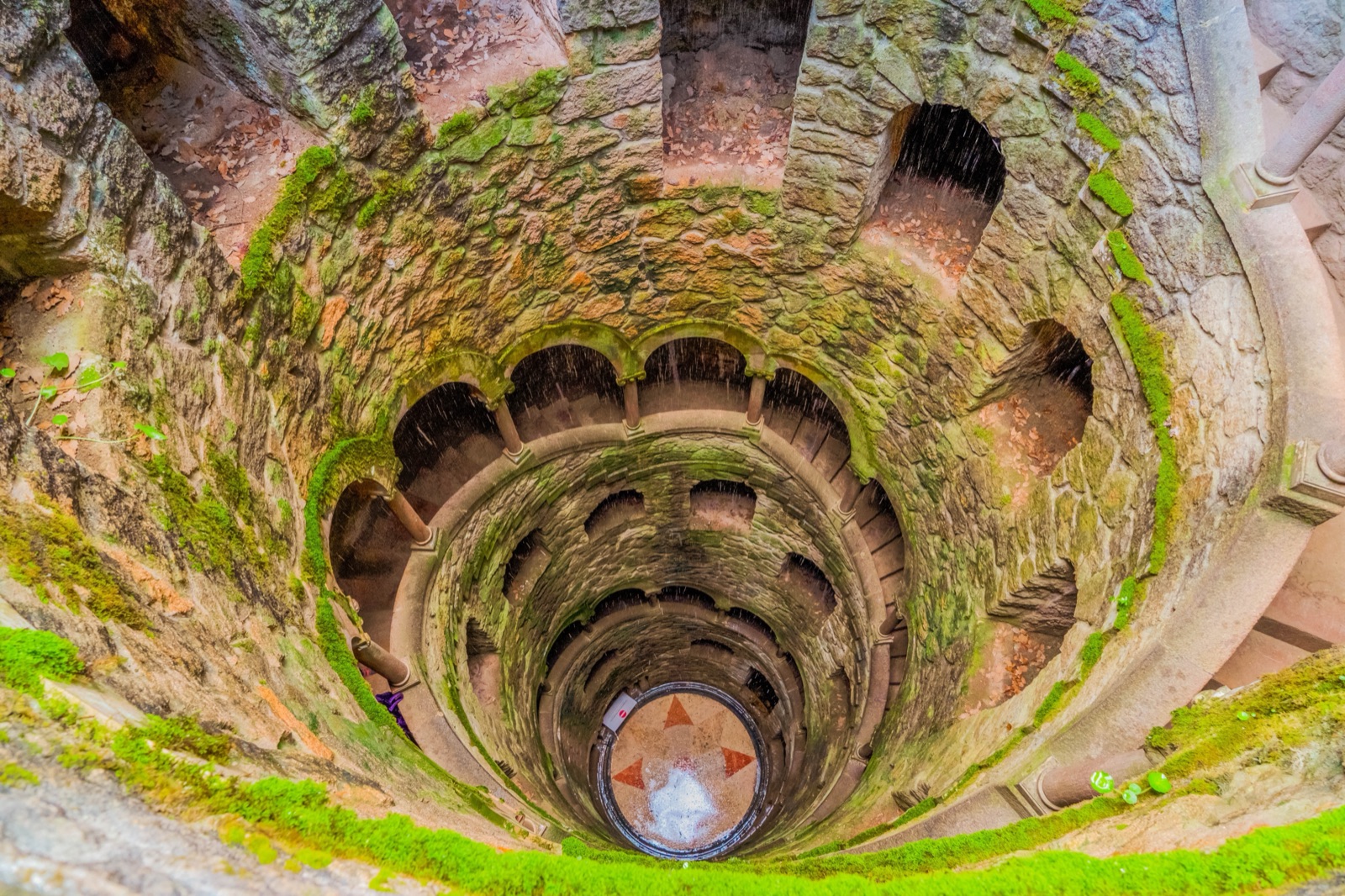
The Initiation Well in Sintra is not a well for water. It is a spiral staircase sunk into the hillside of Quinta da Regaleira, an estate on the edge of Sintra’s historic centre, built in the early twentieth century for the millionaire António Augusto de Carvalho Monteiro by the Italian architect and stage designer Luigi Manini. The Portuguese magazine NiT puts its depth at 27 metres, and its nine levels are often read as the nine circles of hell, the nine sections of purgatory and the nine heavens of paradise in Dante’s Divine Comedy.
Its name, the Poço Iniciático, comes from the belief that it was used for Masonic initiation rituals. That belief has never been proved: Sintra’s municipal tourism site says it is uncertain whether any ritual, or anything like one, ever took place there. You can walk down it today as part of a visit to Quinta da Regaleira, in one direction only, and leave through a tunnel at the bottom. This article explains who built it and why, what its symbols may mean, which stories to take with a pinch of salt, and how to see it without the worst of the crowds.
The Initiation Well at a glance
- What it is: an “inverted tower”, in the words of Sintra’s cultural landscape office: a spiral staircase on carved columns, descending into the ground.
- Where: in the gardens of Quinta da Regaleira, 600 m from Sintra’s historic centre.
- How deep: about 27 metres, with nine levels.
- Who made it: the Italian scenographer Luigi Manini (1848–1936), for António Augusto de Carvalho Monteiro (1848–1920).
- When: as part of the garden completed around 1910; sources date the work 1904–1910 or 1898–1910.
- Why “initiation”: it is believed to have been used in Masonic initiation rituals, but there is no evidence that any took place.
- Visiting today: included in a Quinta da Regaleira ticket; you walk down only, then out through an underground passage.
Quinta da Regaleira before the well
The estate is older than its famous garden. According to Sintra’s municipal tourism site, documentation is scarce, but in 1697 José Leite bought a large plot on the outskirts of the town, roughly matching the present limits of the park. In 1715 Francisco Alberto de Castro bought it at public auction; it became known as Quinta da Torre, or Quinta do Castro, and he brought running water to it from a spring in the Sintra hills. UNESCO’s description of the Cultural Landscape of Sintra, which includes the estate, also dates it to the late seventeenth century.
In 1840 the property passed to Ermelinda Allen, the daughter of a wealthy Porto merchant, who later became Baroness of Regaleira. Local folklore says the name comes from the view from one of the garden towers, which delighted (in Portuguese, regalar) its new owner. At that point, though, the estate was still far from the place visitors see today.
Carvalho Monteiro: “Monteiro of the Millions”
In 1892 the Barons of Regaleira sold the property to António Augusto de Carvalho Monteiro, nicknamed Monteiro dos Milhões, Monteiro of the Millions. He was born in Rio de Janeiro in 1848 to Portuguese parents and moved to Portugal, where he read law at the University of Coimbra. He had a vast fortune and a very particular plan: to build a house that would be anything but ordinary.
Carvalho Monteiro was deeply cultured and a devoted lover of Portugal’s national epic, Camões’ The Lusiads. He wanted his new palace to carry the symbols of the Portuguese nation and to recall its golden age of discoveries, which is why the estate is dressed in Manueline-style ornament, the exuberant late-Gothic style named after King Manuel I. The foundation that runs the estate has exhibited his collection on Camões to mark the poet’s fifth centenary.
His taste for mystery did not stop at Regaleira. In 1918 he had a small, enigmatic romantic-revivalist palace built at the Sanctuary of Peninha, high on the western ridge of the Sintra hills, which is now looked after by Parques de Sintra.
Luigi Manini, the stage designer who built in stone
To make his dream real, Carvalho Monteiro turned to Luigi Manini, an Italian architect and scenographer, whom Sintra’s tourism site calls one of the best set designers of his time. Manini had already completed the neo-Manueline Buçaco Palace Hotel, and he was working at the São Carlos theatre in Lisbon while he drew up the plans for Regaleira. Sintra’s cultural landscape office says his design drew on the scenery he had painted for the São Carlos, particularly for Wagner’s operas, and describes the result as the “petrification” of stage design: theatre sets built in stone. His first scenario in Sintra had been the Sassetti cottage.
On the estate’s four hectares, Manini designed the palace, a chapel, lakes, caves, towers, viewpoints and gardens heavy with alchemical, Masonic, Templar and Rosicrucian symbolism. Construction finished in 1910. The palace’s south wall bears the inscription “This house was built in the year of our Lord 1910”, although the master stonemasons and sculptors only finished their work several years later. The people of Sintra, watching this extraordinary building rise not far from the king’s palace, nicknamed it the Wedding Cake.
Which dates are right?
Sources date the work slightly differently, and the difference is mostly about what is being counted. The foundation says the estate was designed and built in the late 1800s, Sintra’s municipal tourism site dates the building to 1904–1910, and Lisbon’s tourism board gives 1898–1910 for Manini’s transformation of the estate. The house itself is dated 1910 on its wall, and the finishing touches came later.
What the well looks like
NiT describes an underground gallery with a spiral staircase, supported by carved columns, that winds down to the bottom of the shaft. At each level, arched openings look into the central void, and daylight falls from the circular opening at the top. The stone is damp and green with moss, which is unsurprising: Sintra’s foothills are often shrouded in fog.
The photograph at the top of this page, taken from the rim, shows the effect: a corkscrew of arches narrowing towards a star design set into the floor far below. From the bottom, passages lead off through the rock. Sintra’s tourism site says Quinta da Regaleira became famous thanks to the well and the fascination of crossing the property through underground tunnels.
The well is not the only one of its kind on the estate. Sintra’s cultural landscape office speaks of initiation wells, in the plural, which it also calls “inverted towers”, together with underground passages and lakes whose entrance is guarded by a pair of reptilian sculptures, and Leda’s Grotto, a cave scene from Greek myth.
Why is it called the Initiation Well?
NiT explains the name simply: the well is believed to have been used in rituals of initiation into Freemasonry. The idea fits the setting. Sintra’s tourism site says that, according to some authors, the whole estate, heavy with mysticism and “initiation routes”, was purposely created for Freemasons, and the symbols carved into its stone include allusions of Masonic origin.
But the same source is careful to add that, despite the estate’s mystical aura, it is uncertain if any ritual or anything like a ritual ever took place there. No document quoted by the foundation or the municipality shows initiations in the well. The safest way to put it is that the well was built to look like a place of initiation, by a patron fascinated by esoteric ideas and a designer who built theatre sets for a living.
Dante’s nine circles
A popular reading of the well’s design comes from literature rather than secret societies. NiT notes that its nine levels are said to represent the nine circles of hell, the nine sections of purgatory and the nine heavens of paradise in Dante Alighieri’s Divine Comedy. Walking down through the levels into the dark and out through a tunnel into the light would then retrace the poet’s journey.
Sintra’s tourism site supports the link in general terms. It says the estate’s symbols range from easy-to-spot Manueline references to elements related to Dante’s hell, or even to Egyptology, which are harder to identify without some knowledge of symbolism. NiT adds a fair warning: the symbolism is everywhere, but without some reading beforehand it is almost impossible to recognise.
Templars, Masons and Rosicrucians
Sintra’s tourism site lists the traditions that the estate’s symbols are said to evoke: alchemy, Freemasonry, the Knights Templar and the Rosicrucians. Carvalho Monteiro’s palace is described there as a philosophical mansion of alchemical inspiration, and the gardens as a three-dimensional stage set full of symbolic allusions.
None of this means Regaleira was the headquarters of a secret order. What the sources describe is a wealthy, learned man at the turn of the twentieth century commissioning a garden that played with the ideas of his day: national pride, Romantic nature-worship, and the fashion for esoteric symbolism. Sintra’s cultural landscape office links the estate to the Philosophy of Nature and calls it a true genius loci, a place with its own spirit.
Myths to treat with care
The well attracts stories, and some are better than others.
- Harry Potter. The well is often said to have inspired J.K. Rowling’s descriptions of Hogwarts. NiT calls this perhaps a fans’ fancy, as the author has never confirmed it.
- Secret initiations. As above, there is no evidence that rituals took place; the name reflects a belief, not a record.
- An ancient well. The estate’s site goes back to the seventeenth century, but the well itself belongs to the Carvalho Monteiro and Manini garden of the early twentieth century.
From private fantasy to public monument
Carvalho Monteiro died in 1920, and the estate went on to a long private life. In 1942 it was bought by Waldemar D’Orey, who had the architects Luís de Couto and António Lino remodel the inside of the palace for his large family. In 1988 his heirs sold it to the Japanese Aoki Corporation, which kept it closed under the guard of a single caretaker.
In 1997 Sintra City Council bought Quinta da Regaleira and placed it under the management of the Cultursintra Foundation, and in May 1998 it received the first National Historical Heritage Prize from Ford Portugal. The palace, also called the Palace of the Monteiro Millionaire, has been classified as a Property in the Public Interest since 2002, and the estate is part of the Cultural Landscape of Sintra that UNESCO inscribed in 1995.
Its popularity grew fast. According to the Cultursintra foundation, as reported by NiT, 356,646 visits were recorded in the first half of 2017 alone, 42% more than in the same period of 2016.
Seeing the Initiation Well today
The well is part of the self-guided visit to Quinta da Regaleira, with a map. The foundation’s visiting rules, as published on its website in October 2026, include a few points that shape how you see the well:
- Downwards only. Inside the Initiation Well, visitors may only walk down.
- Out through the tunnel. The underground walkway between the well and the Eastern Grotto is one way only.
- No outside guides inside. Guided tours by external guides are not allowed inside the palace or the well, so if you come with a guide, the explanations happen outside.
- The Waterfall Path is closed, and the estate’s Aquarium has been closed for conservation and restoration work since a notice of 16 April 2026.
- Only the main floor of the palace is open to visitors.
- Timed entry. Tickets carry an entry time, with a grace period of up to 1 hour; the foundation recommends buying online in advance to avoid queuing.
- Hours. From October to December the estate opens at 10:00, with last entrance at 17:30 and closing at 18:30; it is closed on 1 January and on 24, 25 and 31 December.
- Practical rules. Suitcases, trolleys and large backpacks are not allowed; visitors under 15 and those with reduced mobility must be accompanied, because of steps and tunnels; and the estate has no car park.
Opening times and rules change with the seasons, so check them before you go. Our guide to Sintra’s palaces and tickets compares Regaleira with Pena, the Moorish Castle and Monserrate and explains timed entry, and a Regaleira ticket with an audio guide handles entry for you. The foundation also rents its own audio guides at the ticket office, with 30 listening points across the palace, chapel and gardens, for €5 including a map.
How to enjoy the well, not just queue for it
NiT counts the well among the most photographed spots on the estate, and that has a cost. NiT’s reporter found that the narrow spiral loses much of its charm when hundreds of people are on it at once. A few ways to give yourself a better chance:
- Choose an early or late entry slot rather than the middle of the day.
- Go to the well first, before the crowd that entered with you finishes the palace.
- Read up before you go. The symbolism is hard to spot without some background, and the audio guide helps.
- Do not rush the tunnel. The walk through the rock to the Eastern Grotto is part of the experience, not just the exit.
Getting there on foot
Quinta da Regaleira is 600 m from Sintra’s historic centre, along the road towards Seteais. On the way you pass the Lawrence Hotel, established in 1764 and described as the oldest hotel in the Iberian Peninsula, where Lord Byron wrote Childe Harold’s Pilgrimage, the poem that called Sintra a “glorious Eden”. Our guide to getting to Sintra from Lisbon covers the train and the buses, and one day in Sintra shows how Regaleira fits into a full day. For the hills and coast around the estate, see our article on the Sintra-Cascais Natural Park, and for fog, rain and the best months, our Sintra weather article.
Frequently asked questions
How deep is the Initiation Well in Sintra?
About 27 metres, according to the Portuguese magazine NiT. A spiral staircase on carved columns winds down through nine levels to the bottom, where tunnels lead off through the rock.
Was the Initiation Well used for Masonic rituals?
Nobody knows. The well takes its name from the belief that it was used for Masonic initiations, and some authors think the estate was designed for Freemasons, but Sintra’s municipal tourism site says it is uncertain whether any ritual ever took place there.
Who built the Initiation Well?
The Italian architect and scenographer Luigi Manini, for the millionaire António Augusto de Carvalho Monteiro, who bought Quinta da Regaleira in 1892. The estate’s house is dated 1910, though some finishing work continued for several years afterwards.
Can you walk down the Initiation Well?
Yes. It is part of the visit to Quinta da Regaleira, but you may only walk downwards, and you leave through a one-way underground walkway to the Eastern Grotto. Outside guides are not allowed to lead tours inside the well.
Do you need a ticket to see the Initiation Well?
Yes. The well is inside Quinta da Regaleira, so you need an entry ticket for the estate, which carries an entry time with up to 1 hour of grace. The foundation recommends buying online in advance to avoid queuing.
Did the Initiation Well inspire Harry Potter?
There is no evidence that it did. NiT notes that the idea may be a fans’ fancy, since J.K. Rowling has never confirmed it. The well’s real inspirations, as far as the sources go, are Dante, Romanticism and esoteric symbolism.