History
The Moorish Castle, Sintra: History of the Castle of the Moors
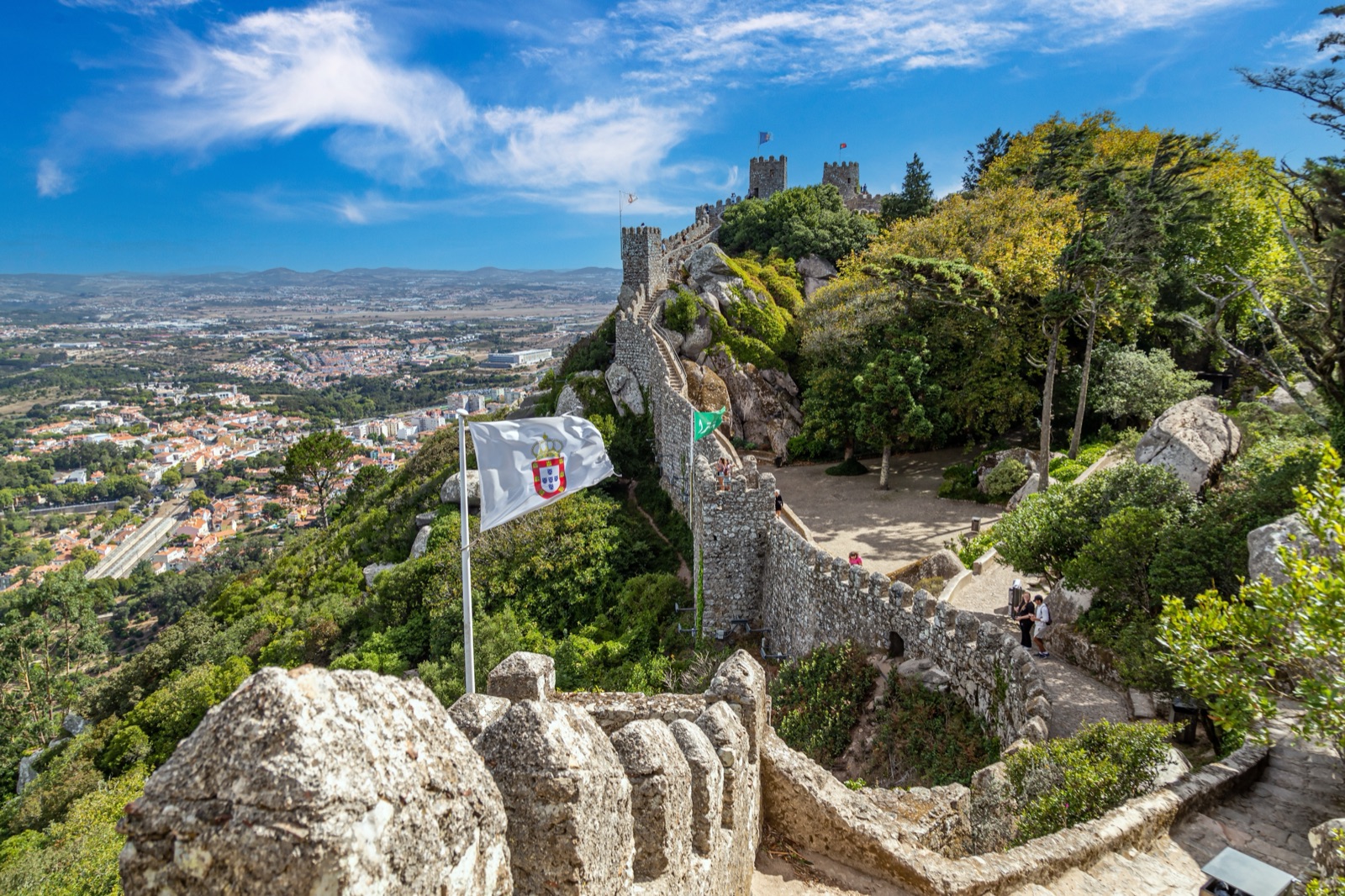
The Moorish Castle, in Portuguese the Castelo dos Mouros and in English often the Castle of the Moors, is the line of grey walls that snakes along a granite ridge above Sintra, next to Pena. Parques de Sintra, which manages it, dates its foundation to the 10th century, while the Moors ruled the Iberian Peninsula; it watched over the land around it and the sea routes into Lisbon. In 1147 it passed to Afonso Henriques, the first king of Portugal, and a Christian village grew up inside and around it, with its own parish church.
By the 15th century the village was emptying, and for centuries the castle was a ruin. What you walk today owes a great deal to King Ferdinand II, who restored it in the 19th century in the Romantic spirit, and to the archaeologists who have been digging there since 1976. This article tells that story from the beginning, explains what the walls, the towers, the church and the silos reveal, and ends with the practical basics of a visit.
The castle at a glance
- Founded: under Islamic rule, in the 10th century according to Parques de Sintra, on one of the peaks of the Sintra hills.
- Changed hands: in 1147, when Sintra was handed over to Afonso Henriques after the conquest of Lisbon and Santarém.
- Medieval village: occupied until the 15th century, with the Church of São Pedro de Canaferrim between the two rings of walls.
- Romantic restoration: by Ferdinand II in the 19th century; the church was turned into a Romantic ruin from 1840.
- Archaeology: excavations since 1976, and an Archaeological Research Field since 2009.
- World Heritage: a fundamental part of the Cultural Landscape of Sintra, inscribed by UNESCO in 1995.
- Managed by: Parques de Sintra, since 2000.
A fortress built under Islamic rule
The castle stands isolated on one of the peaks of the Sintra hills, and the position explains why it was built. From the ridge you look out over the Atlantic coast, the plain to the north and the hills themselves, and the castle held what Parques de Sintra calls a strategic position for defending both the surrounding territory and the sea routes into the city of Lisbon.
The builders used the mountain as part of the defence. The walls run across the hills in granite blocks that link boulders and cliffs, so that the natural rock becomes part of the circuit. The castle does not sit on the ridge so much as grow out of it.
Life in the Islamic Quarter
The finds on the site show that between the walls and the ground beside them lived a population, in an area now called the Islamic Quarter. Archaeologists have found the remains of houses, silos and the foundations of a community oven.
From pottery fragments found over a series of digs, it has been possible to reconstruct the Islamic material culture of the 10th to 12th centuries here: pans, jugs, pots, amphoras, baking dishes, bowls and bottles. Parques de Sintra notes that the interiors of these homes were used above all for preparing food and for weaving wool, and the site has yielded spinning tools, among them spindles made of copper alloy.
The silos
The silos are the castle’s most distinctive Islamic feature. They are cavities cut into the bedrock, semi-spherical in shape but of different sizes and depths, used to store cereals and pulses. Storing grain this way was known from prehistory, but Parques de Sintra explains that it was introduced on a large scale in al-Andalus by the Moors who settled there, and the technique is described in Arabic agricultural treatises. Silos have been identified across the whole castle area, both inside the fortification and outside it.
1147: Sintra changes hands
The Moors lived here until 1147. That year Afonso Henriques, the first king of Portugal, conquered Lisbon and Santarém, and Sintra was handed over to him. It was not taken by storm. Sintra’s municipal tourism site records that after taking Santarém, Afonso Henriques besieged Lisbon for three months, and that Sintra’s castle surrendered voluntarily once Lisbon had fallen.
To hold and defend the new territory, the running of Sintra and its surroundings was given to Gualdim Pais, a master of the Knights Templar, who received a charter in 1154. Afonso Henriques entrusted the castle’s care and defence to the Templars, who reworked the defences that had long existed and built new ones.
The Templars and the second ring of walls
The most visible result of that work is a second line of walls. Parques de Sintra explains that it was built to give better protection to the people who lived around the castle, with their animals and their harvests, and that its existence shows there was a population of considerable size in the castle’s immediate surroundings.
The castle you see is therefore not one building from one moment: the construction phases are visible in the walls themselves, and the differences in the masonry are part of the story.
The medieval village and its church
With the arrival of Christian settlers, the Islamic Quarter gradually disappeared and gave way to a medieval town, which was occupied until the 15th century. At its heart stood the Church of São Pedro de Canaferrim, built between the two rings of walls.
The church was built in the 12th century, after the conquest of 1147, and it was the first parish church of Sintra. Parques de Sintra says it remained a place of worship until the 14th century. It is built of granite masonry with very thick walls, and its apse still shows remains of Gothic paintings dating from the 15th century.
Beside the church lay the village’s cemetery, and its position says a great deal about the conquest. The Islamic population had lived on the most sheltered side of the hills, where the remains of their homes, an oven and silos survive. After Afonso Henriques took the castle, that neighbourhood was destroyed and turned into the Christian burial ground of São Pedro de Canaferrim. The necropolis dates from the 12th to the 14th centuries and lies directly over the Islamic quarter of the 10th to 12th centuries. Excavation showed it was in use for around 300 years, with graves that each held more than one person, adults and children together. The same digs turned up many Neolithic artefacts, including a complete vase, evidence of people here long before the Moors.
Decline and abandonment
The village did not end in a single disaster. By the 15th century, Parques de Sintra explains, the site was gradually abandoned: with the wars between Moors and Christians long over, people no longer felt the need to live in the shelter of a fortress on a mountain.
The church went the same way, though the sources date it differently. Wikipedia’s account, drawing on Portugal’s heritage inventory, says the chapel was still in religious use at the beginning of the 15th century, later than Parques de Sintra’s date, but that by 1493 it had been abandoned and was later used by the parish’s small Jewish community, until the Jews using the castle’s buildings were expelled under Manuel I. In the 16th century the parish of São Pedro moved down from the castle to a new parish church in the village. One of the earliest images of the castle dates from this period: Duarte de Armas drew it in 1510 for his Book of Fortresses.
Then came centuries of neglect. Sintra’s municipal tourism site describes trees and bushes taking over the walls, sections collapsing, and shepherds and cattle as the old fortress’s only guards. The great Lisbon earthquake of 1755 made matters worse, causing considerable damage to the chapel and affecting the stability of the castle as a whole. By 1838, the same Wikipedia account notes, the towers were in ruins.
Ferdinand II’s Romantic castle
In the 19th century the castle found a patron with a very different purpose. King Ferdinand II, the consort who was building Pena Palace on the next peak, undertook restoration work on the castle in keeping with the Romantic spirit of the time, breathing new life into the medieval imagery of the site. UNESCO describes nineteenth-century Sintra as the first centre of European Romantic architecture, and the castle became part of that landscape, a ruin to be walked as a place of contemplation.
Ferdinand’s work was restoration in the Romantic sense, not archaeology. He began in 1840, and the works were overseen by Baron Wilhelm Ludwig von Eschwege, who also supervised the building of the palace at Pena; Wikipedia notes that they probably made later archaeological work on the site harder. From 1840 the Church of São Pedro de Canaferrim was turned into a Romantic ruin, set into the forest of the Park of Pena.
The tomb of the unknown dead
The works had a side effect. They damaged part of the church’s Christian burial ground, and Ferdinand II ordered a tomb to be built to house the bones found there. Since no one could tell whether the remains were Christian or Moorish, the tombstone was carved with a lunar crescent and a cross, and with the inscription: “What man brought together, only God may separate”.
Archaeology since 1976
The castle has been excavated since 1976. In 2000 Parques de Sintra took over the management of this national monument, and in 2009 it set up an Archaeological Research Field to deepen and share knowledge of the castle’s human occupation, its construction phases and its living quarters.
The finds are now on show in the castle itself. The Church of São Pedro de Canaferrim houses the Historical Interpretation Centre of the Moorish Castle, which tells the story of the peoples who lived here, from the Neolithic to the Middle Ages, through objects from the excavations of 2009 to 2013 and interactive displays. It is worth visiting before you climb the walls: the silos and house foundations make more sense once you have seen the pots and spindles that came out of them.
What you see on the walls today
The castle covers an irregular area of about 12,000 m2 inside a double curtain wall, the outer ring now partly destroyed. Sintra’s tourism site points out that it stands on a large granite outcrop that formed an insurmountable natural defence to the north, and that it winds across two ridges of the hills. The main features are these:
- The Church of São Pedro de Canaferrim and the interpretation centre, between the two rings of walls.
- The silos and the Islamic settlement, cut into the rock and scattered across the site, with the foundations of houses and a community oven.
- The former stables: against the eastern wall, the ruins of two once-roofed rooms whose purpose is not known for certain. They are thought to have served first as stables and later as pens for animals, and inside them are the foundations of a Moorish house.
- The cistern: a rectangular, vaulted water tank, 18 metres long and 6 metres wide according to Sintra’s tourism site, holding around 600 m3, with two ventilation chimneys on top. Parques de Sintra explains that it gave anyone sheltering in the castle a real advantage in sitting out a siege. Its granite blocks were reused from an earlier structure, and its mason’s marks and pointed-arch doorway date it to the 13th century, after the Christian conquest.
- The Arms Square: the broadest open space in the castle, a walled square open to the sky where the garrison once gathered. Ferdinand II turned it into a place of rest and contemplation, and Parques de Sintra presents the horseshoe-arch entrance in the wall as part of that 19th-century work, a deliberate nod to the Moorish past.
- The Castle Keep: the castle’s last stronghold, a small fortified core where the local authorities lived, part of the main Keep Tower. It stands at one of the highest points of the walls and can be seen from the plains north of the hills and from the sea. Parques de Sintra records that Sigurd I, King of Norway, spotted the tower from offshore and visited the castle in 1109, during the Islamic period.
- The Royal Tower: opposite the keep and the highest point of the walls, with the view of the Sintra hills and Pena that most people come for. With the palace as its backdrop, Parques de Sintra says it would have been a favourite spot of Ferdinand II, known as the King-Artist, who came here for inspiration.
- The Door of Betrayal: at the northernmost end, tucked into the curtain wall. In a conflict it gave discreet access to the outside and, as a last resort, a way to flee; but as an opening in the wall it could also let the enemy in, hence the name. Doors like it were usually placed in the most uneven and least used part of a fortification.
Parques de Sintra’s own one-day walking route allows about 10 minutes for the Arms Square, 10 for the keep, 20 for the walk along the walls and 15 for the Royal Tower: roughly an hour on the walls alone, before the church, the silos and the views. Expect steep steps and uneven stone; hold on in wind, and keep children close.
Reading the castle honestly
It is tempting to see the walls as a Moorish fortress frozen in time. They are not, and the sources are frank about it.
- The founding date is debated. Parques de Sintra dates the foundation to the 10th century. Sintra’s municipal tourism site says the origins are not yet fully understood: some researchers have argued for the 7th century, under the Visigoths, mainly because of the way the walls were built, while most date the fortress to the 8th or 9th century, in the Moorish period.
- The legend is a legend. Local tradition tells of a Templar, Dom Gil, sent with twenty men to watch the Moors of Sintra. Between Colares and Penedo the Virgin is said to have appeared to them and told them not to be afraid, for “there are twenty of you, but you are worth one thousand”, and the Chapel of Our Lady of Milides in Colares was built to commemorate their victory. It is a good story, not a record.
- Much of the silhouette is 19th-century. After centuries in which trees and bushes took over the walls and parts of them collapsed, with shepherds and cattle as their only guards, Ferdinand II had Eschwege restore and consolidate the walls and towers around the middle of the 19th century. He also had the whole area around the walls planted with trees on both sides, which is why the castle now rises out of forest rather than bare rock.
The stones show at least three ages: the Islamic fortress and its village, the Christian refortification with its second ring of walls and its church, and the Romantic reconstruction that gave Sintra its skyline.
Visiting the castle
The basics, as listed by Parques de Sintra in October 2026:
- Tickets: €12 for adults, €10 for youths (6–17) and seniors (over 65), €33 for a family of two adults and two youths. Buying it with other Parques de Sintra sites in one purchase brings a discount; our guide to Sintra’s palaces and tickets explains how that works.
- Hours: 9:30–18:00, with last ticket and last admission at 17:30. The ticket office closes from 12 pm to 1 pm, with machines available.
- Getting there: bus 434 from Sintra station, or on foot on the marked Santa Maria trail (1,770 metres, about 1 hour) or the Villa Sassetti trail (1,850 metres, about 45 minutes). Access to the castle is prohibited to private vehicles.
- Dogs are welcome.
- With Pena: the two share a ridge, and the park’s own walking route goes from the castle to the main entrance of the Park of Pena and up to the palace in about 30 minutes. Our Pena Palace guide explains how to time your palace slot.
The castle sits in the forest of the Sintra hills, so it can close at short notice in high winds or when fire risk is high, as the forest sites did in July 2026. Check before you go.
Our guide to one day in Sintra shows how the castle fits into a day with the National Palace and Pena, and the guide to getting to Sintra from Lisbon covers the train and bus 434.
Frequently asked questions
Who built the Moorish Castle in Sintra?
It was founded under Islamic rule; Parques de Sintra dates it to the 10th century, while other researchers argue for the 8th or 9th. After 1147 the Knights Templar reworked it and added a second ring of walls, and in the 19th century King Ferdinand II restored it in the Romantic style.
When was the Moorish Castle conquered?
In 1147, when Sintra was handed over to Afonso Henriques, the first king of Portugal, after his conquest of Lisbon and Santarém.
Is the Moorish Castle original or a reconstruction?
Both. The line of the walls, the silos, the church and the house foundations are medieval or older, but much of what you walk was restored by Ferdinand II in the 19th century, and the construction phases are visible in the stonework.
Is the Moorish Castle worth visiting?
Yes, if you like views and walking. The Royal Tower gives the classic view of Pena, and the interpretation centre explains the archaeology. It is a walk on stone steps, not a building with rooms.
How long do you need at the Moorish Castle?
Allow a couple of hours, including the walk along the walls, the towers and the interpretation centre. The park’s own itinerary gives about 30 minutes from the castle to Pena Palace on foot.
Can you visit the Moorish Castle and Pena on the same day?
Yes. They stand on the same ridge and are linked by a signposted footpath. Book a Pena palace slot that leaves time for the castle first.