Where to Stay in Sintra: Best Areas, Lisbon or Cascais, and How Long
If you want to see Sintra properly, stay in Sintra itself for at least one night, in or near the historic centre or by the train station. Sleeping here means you can be at the gate of Pena Park when it opens at 9:00, take the first palace slot at 9:30 and see Quinta da Regaleira or the National Palace before the day trips from Lisbon arrive. Stay in Lisbon instead if Sintra is a single day in a city break: the train from Rossio takes about 45 minutes. Choose Cascais if you want the beach, and the countryside around Colares or the coast at Praia das Maçãs if you have a car and want quiet.
Sintra’s municipal tourism service groups places to stay into three kinds: town, countryside and beach. This guide goes through each area, what it is like to stay there, how you get to the palaces from it, what to know about cars and luggage in a town where the historic centre is for residents’ vehicles only, the tourist tax, and how many nights make sense. It does not recommend individual hotels; prices and availability change too fast. Practical details are as published by the council, Parques de Sintra and the transport operators in November 2026.
The short answer
| Base | Best for | To Pena | Main drawback |
|---|---|---|---|
| Historic centre | First visits, walking, evenings | On foot (Santa Maria trail, ~1 h to the castle) or bus 434 | Steep, cobbled, no cars |
| Station / Estefânia | Arriving by train, luggage, the tram | Bus 434 from the station | Less atmospheric |
| Hill estates and quintas | A special stay | Short drive or taxi to a car park, then bus | Need a car or taxis |
| Colares and countryside | Quiet, wine, the western hills | Car, or bus 1253 | Few buses |
| Beach (Praia das Maçãs, Azenhas) | Summer, sea, sunsets | Car, or the tram and bus | Far from the palaces |
| Cascais | Beach town plus Sintra | Bus 1624 or 1623 to Portela de Sintra, then on | Longer daily trip |
| Lisbon | A city break with one Sintra day | Train from Rossio, ~45 min | You arrive with the crowds |
Why stay overnight at all
Most of Sintra’s visitors come for the day, and that shapes the crowds. In 2025 the monuments run by Parques de Sintra had 3.1 million visitors, 1.9 million of them at Pena. An overnight stay lets you work around them:
- Early starts. The Park of Pena opens at 9:00 and the palace at 9:30; the Moorish Castle and the National Palace open at 9:30. From the town, you can be first in the queue without an early train.
- A second morning. With two mornings, you can do Pena on one and Regaleira (9:00 from April to September) on the other, both at their quietest.
- The evenings. Regaleira’s guided night visit, in Portuguese, ran once a month at 21:30 from April to October in 2026. Without a bed nearby, the last train back makes evening events hard.
- Flexibility with the weather. Sintra’s hills are often in fog in the morning, and a local saying holds that the weather “will clear up after lunch”. If you are staying, a foggy morning just means swapping the order of the day.
The historic centre
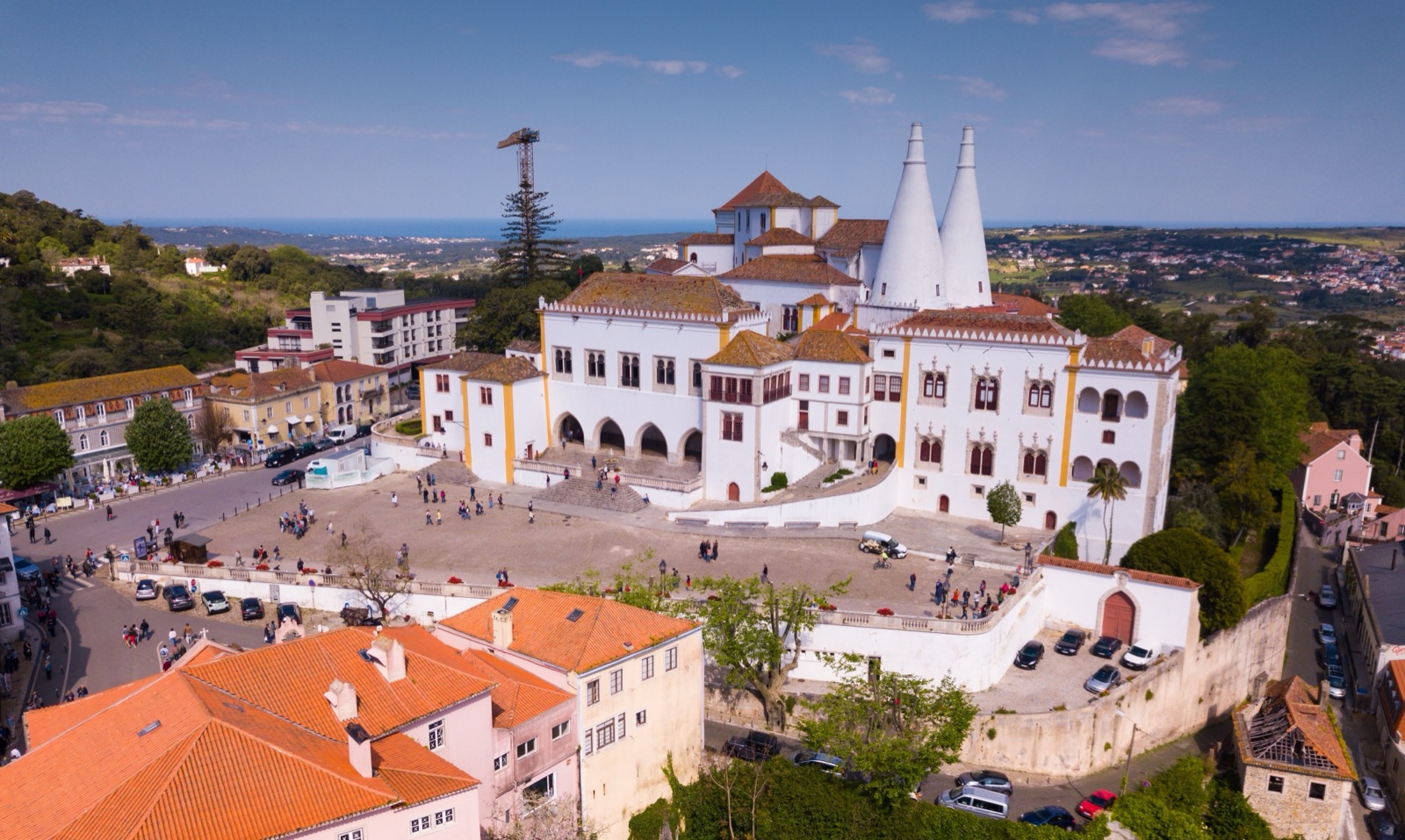
The old town, around the National Palace on Largo Rainha D. Amélia, is where most people imagine staying, and with reason. You are on the doorstep of the National Palace, 600 m from Quinta da Regaleira, at the start of the marked footpaths up to the Moorish Castle and Pena, and among the cafés and restaurants.
What to know before you book:
- No cars. Private vehicles may only circulate in the historic centre if they belong to residents. If you are driving, ask your accommodation exactly where to park and how to bring luggage in.
- Hills and cobbles. The centre is built on the side of the hill. Rolling a suitcase from the station takes 10–15 minutes and some of the lanes are steep.
- The walking routes start here. Visit Sintra’s Short Route 1 and Short Route 2/3 both begin at the National Palace, and the Villa Sassetti trail to the castle and Pena starts from Largo Ferreira de Castro, nearby. See our hiking guide.
- Old buildings. Expect historic houses on sloping streets, so check for lifts and stairs if that matters to you.
The historic quarter also has a long hotel history. The Lawrence Hotel, on the way to Regaleira, was established in 1764 and is described as the oldest hotel in the Iberian Peninsula; Lord Byron wrote Childe Harold’s Pilgrimage, which calls Sintra a “Glorious Eden”, there. A century later Victor Carlos Sassetti, the owner of the Hotel Victor in Sintra, had his summer house built on the slope above the town, the house you now walk past on the Villa Sassetti trail.
Near the station and Estefânia
The area around Sintra station and the Estefânia quarter is the practical choice, with the trains, the buses and the tram on the doorstep.
- Trains: CP’s Sintra line runs from the station to Lisbon’s Rossio (about 45 minutes) and Oriente (about 50 minutes).
- Buses: the 434 to the Moorish Castle and Pena, the 435 to Regaleira, Seteais and Monserrate, and the Carris Metropolitana 1253 to the Capuchos area and Cabo da Roca all leave from the station.
- The tram: the Sintra tram runs almost 11 kilometres from Vila Alda in Estefânia to Praia das Maçãs, in about 45 minutes, with tickets bought on board.
- The walk in: the National Palace is 10–15 minutes on foot from the station.
You lose a little of the old-town atmosphere, but gain a much easier arrival and departure, especially with bags.
The hill estates and quintas
On the slopes west of the centre, along the road towards Seteais and Monserrate, lie Sintra’s old “quintas”: traditional estates and manor houses with gardens and views. Visit Sintra’s Short Route 5 walks past several of them, including Quinta do Relógio and Quinta do Castanheiro. Some historic properties here take guests; the best known is the Palace of Seteais, an 18th-century neoclassical palace that is now a hotel.
Staying on the hill feels secluded and very Sintra, but think about transport. Bus 435 serves Regaleira, Seteais and Monserrate, and the centre is walkable on the Seteais trail (2,410 metres, about 1h30, waymarked from the Palace of Seteais), but for most trips you will want a car or taxis.
Colares and the countryside
West and north of the hills, Sintra turns into farmland, pine woods and vineyards: the “saloio” countryside of small villages. Colares has made wine for centuries, protected since 1908 as a demarcated region, and the Adega Regional de Colares, founded in 1931, is Portugal’s oldest winery cooperative.
This is the place for a quiet stay among rural houses and wine estates, and a good base for the western sights: Monserrate on the EN375 road from Sintra to Colares, the Convent of the Capuchos, Peninha, Cabo da Roca and the beaches. The downside is transport. Buses exist (the 1253 circular from Sintra station via Cabo da Roca; line 1624 between Cascais and Portela de Sintra through Almoçageme), but a car makes this area far easier. Our guide to the Convent of the Capuchos covers the roads into the western hills.
The beach villages
Sintra’s coast is wild Atlantic, with beaches below cliffs and small villages above them:
- Praia das Maçãs, at the end of the tram line, has seaside restaurants and is the easiest beach to reach without a car.
- Azenhas do Mar is a village on the cliffs above a small beach and an ocean pool, named after the water mills that once stood on its stream.
- Praia Grande is the surf and bodyboard beach; it hosts the only European stage of the world bodyboarding circuit.
In 2026 the lifeguarded bathing seasons on these beaches ran from 30 May to 13 September. Staying on the coast is lovely in summer, with sunsets over the sea, but you are a bus, tram or drive away from the palaces each morning. Visit Sintra’s own 2-day route suggests ending a Sintra day at a seaside restaurant at Maçãs, Grande or Adraga beach for the sunset. Our article on Cabo da Roca and the Sintra beaches describes each beach.
Cascais as a base
Cascais, on the coast south of the hills, is a popular base for a beach holiday with a Sintra day included. To get to Sintra:
- Bus 1624 runs from Cascais bus terminal via Azóia and Almoçageme to Portela de Sintra station, serving Cabo da Roca on the way, so you can combine the cape with Sintra.
- Bus 1623 runs from Cascais bus terminal via Alvide to Portela de Sintra.
- By car, the EN9 from Cascais (via the A5) leads to Sintra, and the EN247 runs from Cascais to Colares past the Cabo da Roca turning.
Both buses end at Portela de Sintra, on the edge of the town, not at Sintra station, so allow for the connection into the centre. Cascais works well if the beach is the main event, less well if you want to be at Pena at opening.
Lisbon as a base
For many travellers Sintra is one day of a Lisbon trip, and staying in the city is perfectly sensible:
- From Rossio, in Lisbon’s Baixa, trains to Sintra leave frequently and take about 45 minutes.
- From Oriente, the journey is about 50 minutes, and Oriente is 10 minutes by metro from the airport.
- Tours from Lisbon handle the tickets and transport, which helps in busy months.
The trade-off is timing: by the time you arrive, so has everyone else. To make the most of a day trip, take an early train, book Pena’s first slot and follow a plan like the ones in our one day in Sintra guide. The getting to Sintra from Lisbon guide covers trains, tickets and the buses at the other end.
Cars, parking and luggage
Sintra is hard on drivers, and that affects where you should stay:
- No private cars to Pena or the Moorish Castle, and the historic centre is for residents only.
- On-street parking is time-limited, paid at meters with euro coins or through local apps.
- Peripheral car parks are the council’s advice. The Lourel car park has 509 free spaces with public transport on to the town and the monuments, and tour coaches now drop passengers there instead of entering the village.
- Visit Sintra’s 2-day route suggests drivers start at Portela de Sintra, park, and take bus 434 into the historic centre.
If you are driving, choose accommodation with its own parking, or on the edge of town, and leave the car there. If you are arriving by train, the station area or the centre are the easy options.
The tourist tax and finding a place
- Tourist tax: Sintra’s municipal tourist tax, in force since 16 February 2019, is €2 per guest per night, up to a maximum of 3 consecutive nights. It is charged by hotels and local accommodation on top of the room price.
- Local accommodation: the council’s Sintra INN project is a platform presenting the municipality’s local accommodation (guesthouses, rooms and apartments).
- Booking: Visit Sintra advises contacting the accommodation’s managers or owners directly for reservations.
How many nights?
- One night is enough to do Pena and the Moorish Castle at opening on one day and Regaleira or the National Palace the next morning, before leaving.
- Two nights let you add Monserrate, the Capuchos, Cabo da Roca and a beach without rushing. Visit Sintra’s 2-day route goes Pena, lunch in São Pedro de Penaferrim and Regaleira on day one, then the National Palace, the town’s museums and Cabo da Roca at sunset on day two (the tourist office at the cape issues a certificate for reaching continental Europe’s westernmost point).
- Three nights or more suit walkers and anyone who wants the hiking trails, the wine country and the coast.
A sample two-day stay
Day 1: the hills. Be at the Park of Pena for 9:00 and take the first palace slot. Walk down to the Moorish Castle (the signposted path takes about 30 minutes), then descend to the town on the Villa Sassetti trail. Lunch in the centre, then Quinta da Regaleira in the afternoon.
Day 2: town and coast. The National Palace at 9:30, before the tour groups, with a coffee in the Lion Patio cafeteria. Then the 1253 bus or a drive west to Monserrate or Cabo da Roca, and an evening at Praia das Maçãs, perhaps by tram.
Book Pena and Regaleira ahead for the slots you want; the other Parques de Sintra monuments only need a date, and online tickets can be rescheduled within a year. Our guides to Pena Palace and Quinta da Regaleira explain the slots, and the best time to visit Sintra guide covers seasons and closures, including the four days around Christmas and New Year when the monuments shut. Prefer a driver? Compare tours on our tours page.
Frequently asked questions
Is it better to stay in Sintra or Lisbon?
Stay in Sintra if you want to see the palaces at opening, before the day-trippers, or you have more than one day. Stay in Lisbon if Sintra is a single day trip: the train from Rossio takes about 45 minutes.
What is the best area to stay in Sintra?
The historic centre for atmosphere and walking, or the station and Estefânia area for easy arrival, trains and the tram. Choose the countryside or the coast if you have a car and want quiet.
Can you stay near Pena Palace?
Pena sits on a hilltop inside its park, with no private cars allowed up to it. The nearest practical bases are the historic centre, from which footpaths lead up to the Moorish Castle and Pena, and the station area, served by bus 434.
Is there a tourist tax in Sintra?
Yes. Since 16 February 2019, guests pay €2 per person per night, up to a maximum of 3 consecutive nights.
How many days do you need in Sintra?
One full day covers the highlights; two days, with a night in between, let you see Pena and Regaleira at their quietest and add Monserrate, the Capuchos or Cabo da Roca.
Is Cascais a good base for Sintra?
Yes, for a beach holiday. Buses 1624 and 1623 link Cascais with Portela de Sintra, the 1624 via Cabo da Roca. It is less convenient than staying in Sintra if you want early starts at the palaces.